Client:Industrial Sack & Packaging Manufacturer · Guadalajara, Mexico
Integrator:KDS Energía Eficiente
Distributor:Battery Depot (Mexico)
Inverter Platform:Victron Energy
Battery Platform:Pytes V5
Application:C&I · Peak Shaving · Demand Charge Reduction
Operating Mode:Adaptive Discharge — Learns from Load Behavior
The Economics of Demand Charges
For industrial operators in Mexico, the electricity bill is not one number. It is two.
The first is the energy charge — what you pay per kilowatt-hour consumed. The second is the demand charge — what you pay for the highest power draw during the peak window each month, applied across the entire billing cycle.
Under CFE's industrial time-of-use tariff structure, demand charges can account for a substantial share of the total bill. A factory that hits a brief peak at 2:00 PM on a Tuesday pays for that peak across every hour of the month. The line doesn't have to stay there. It just has to touch there once.
For a 24/7 packaging manufacturer in Guadalajara — running extruders, heavy motors, and continuous production lines — those peaks are unavoidable when relying on the grid alone. They are baked into the operating profile. Until storage rewrites the equation.
“Energy cost is critical for us because our product cost depends on it. We had to adopt this system specifically to bring production costs down and make our product more competitive.”
— Client
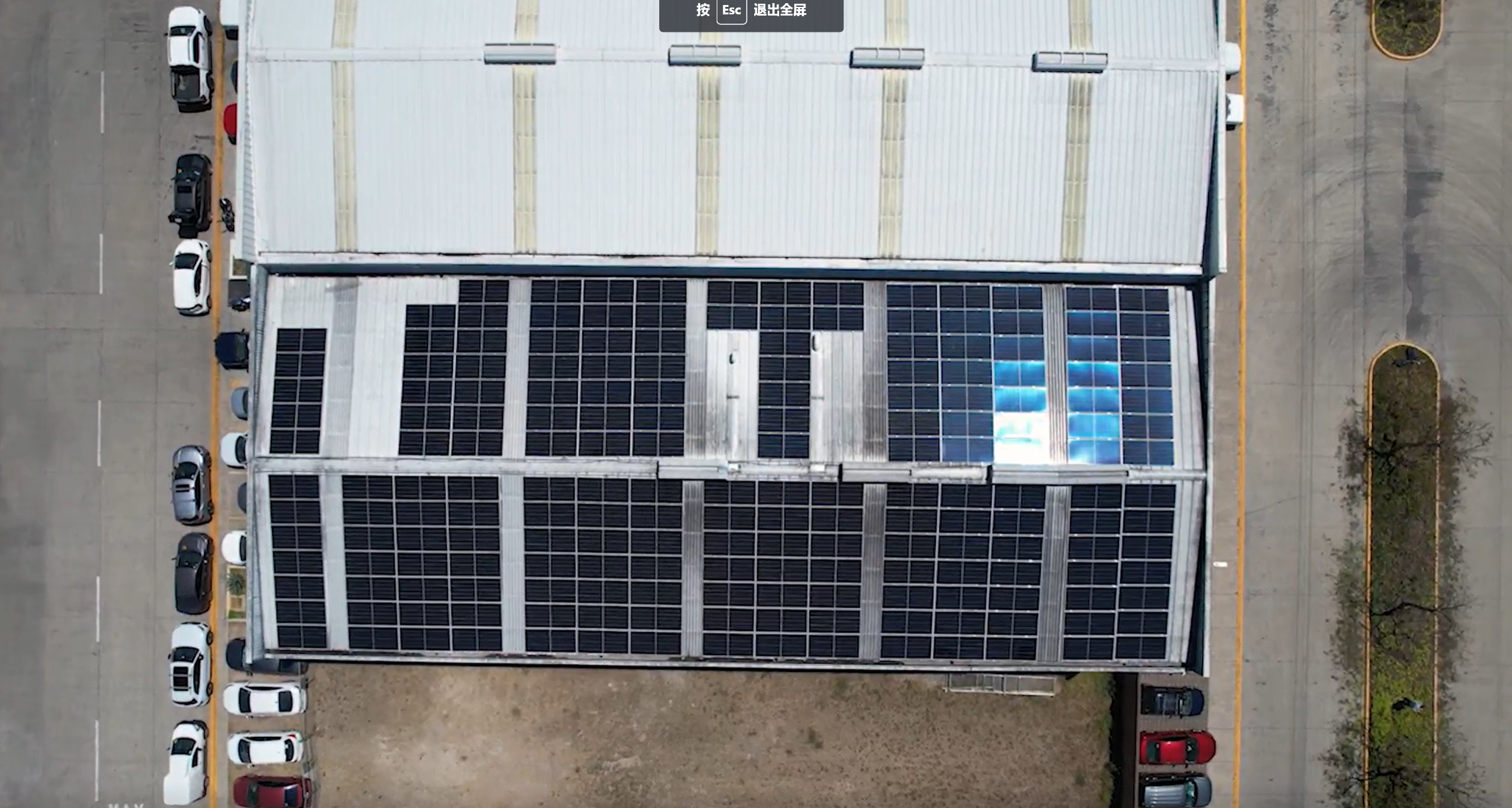
KDS Energía Eficiente's process starts with a load profile audit — the actual demand curve mapped against the tariff structure. For this site, the audit confirmed two opportunities operating in parallel:
1)Peak shaving — discharge stored energy during the brief, high-cost demand windows to flatten the metered peak.
2)Energy arbitrage — charge the battery bank during off-peak hours, discharge during peak energy-rate windows.
Both strategies share the same hardware. Both require the same engineering discipline. Neither is a residential install scaled up.
Industrial deployments at this scale introduce constraints consumer-grade systems aren't built for:
1)Three-phase architecture — production loads are three-phase; storage must match
2)Sustained high-rate discharge — peak shaving demands real power dispatch, not just energy capacity
3)Mission-critical uptime — a single missed peak window can erase a month of savings
4)Adaptive dispatch — fixed schedules don't track real production variation
5)Space constraints — the site has no dedicated battery room
“This is not a residential or small commercial project. It is industrial-scale, and it is relatively new in our industry. We had to size it through deep load profile analysis and select equipment that delivers at industrial scale.”
— KDS Energía Eficiente
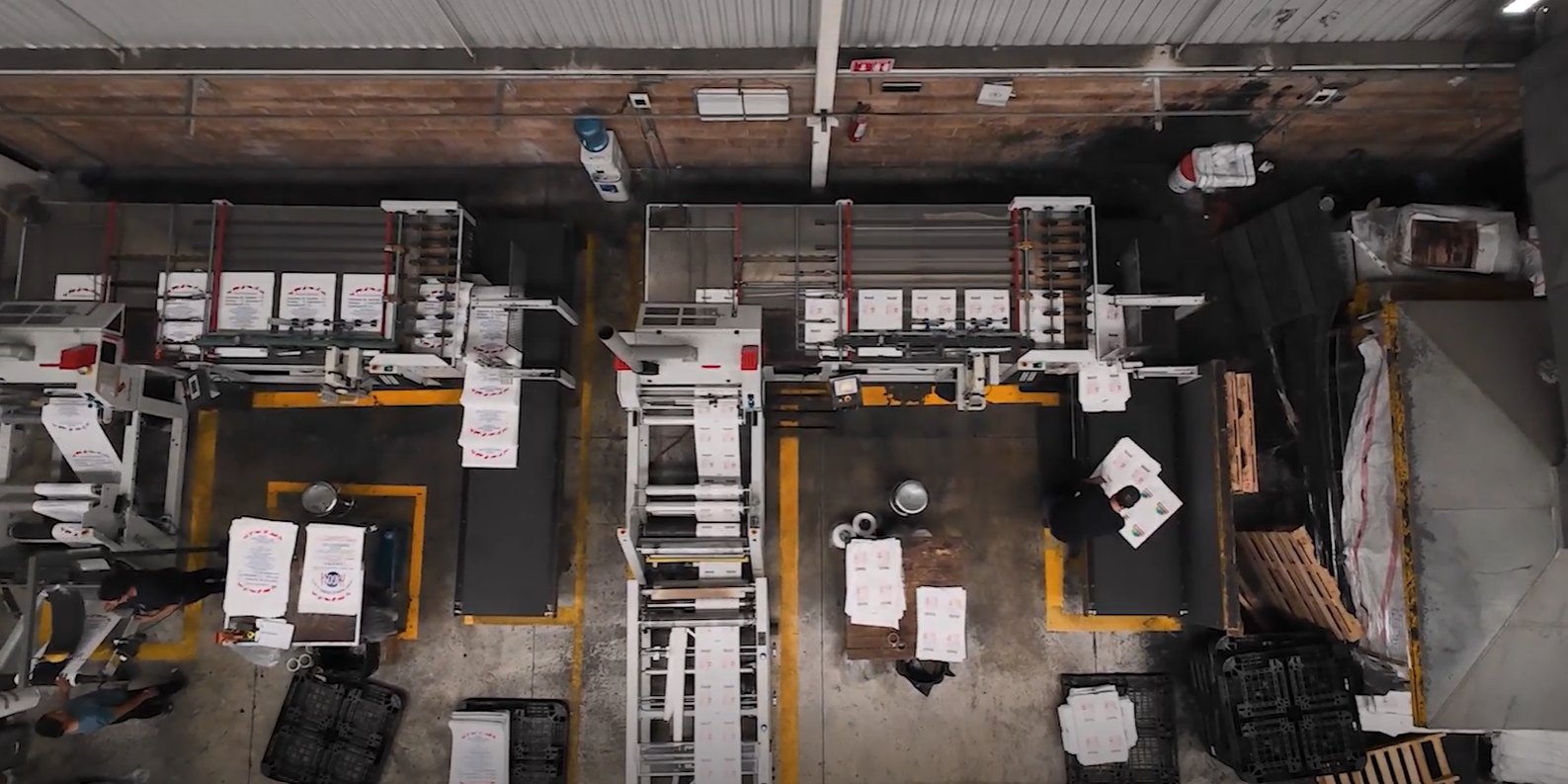
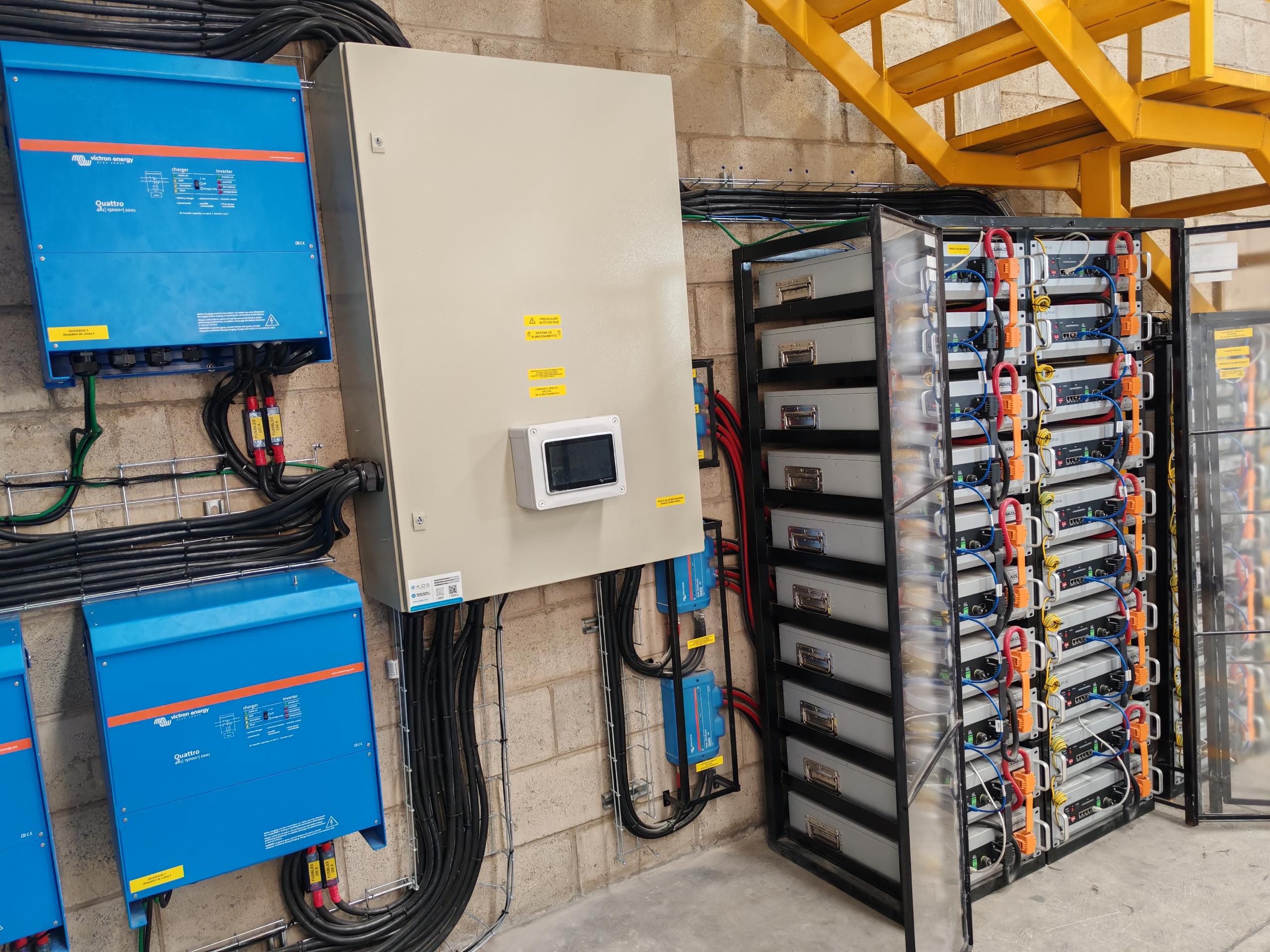
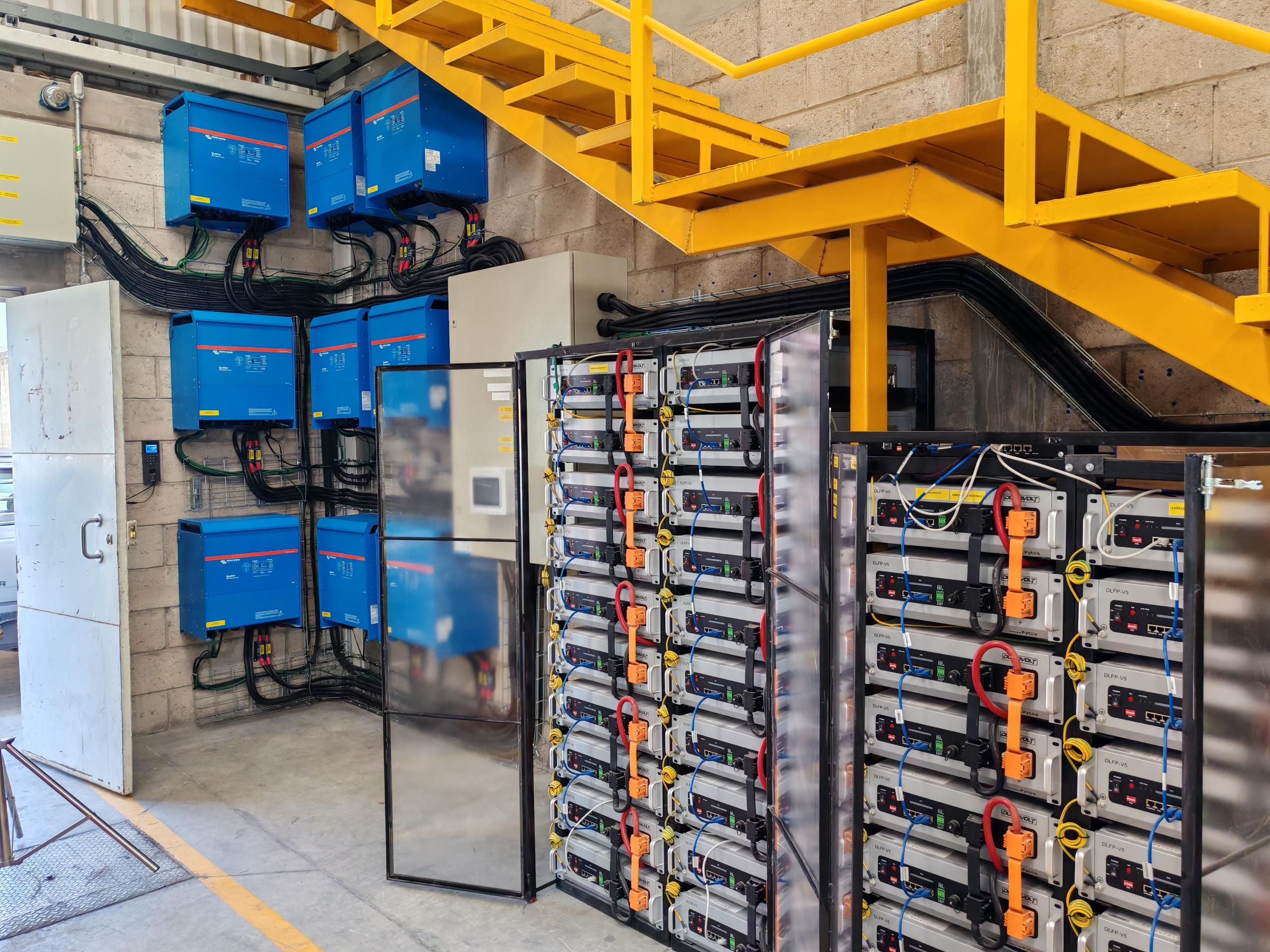
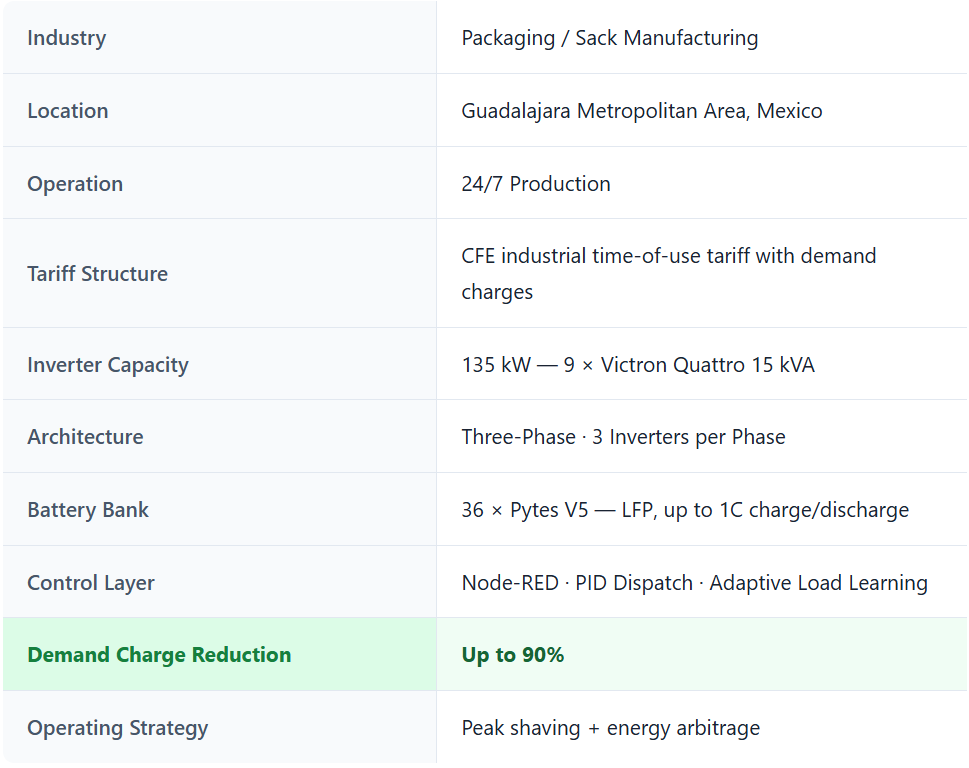
Nine Victron Quattro 15 kVA inverters in three-phase configuration: three inverters per phase, paralleled for 135 kW of total conversion capacity. The Quattro platform is engineered for continuous industrial duty cycles and the harmonic loads typical of manufacturing equipment. Three-phase output is delivered cleanly to the existing factory distribution.
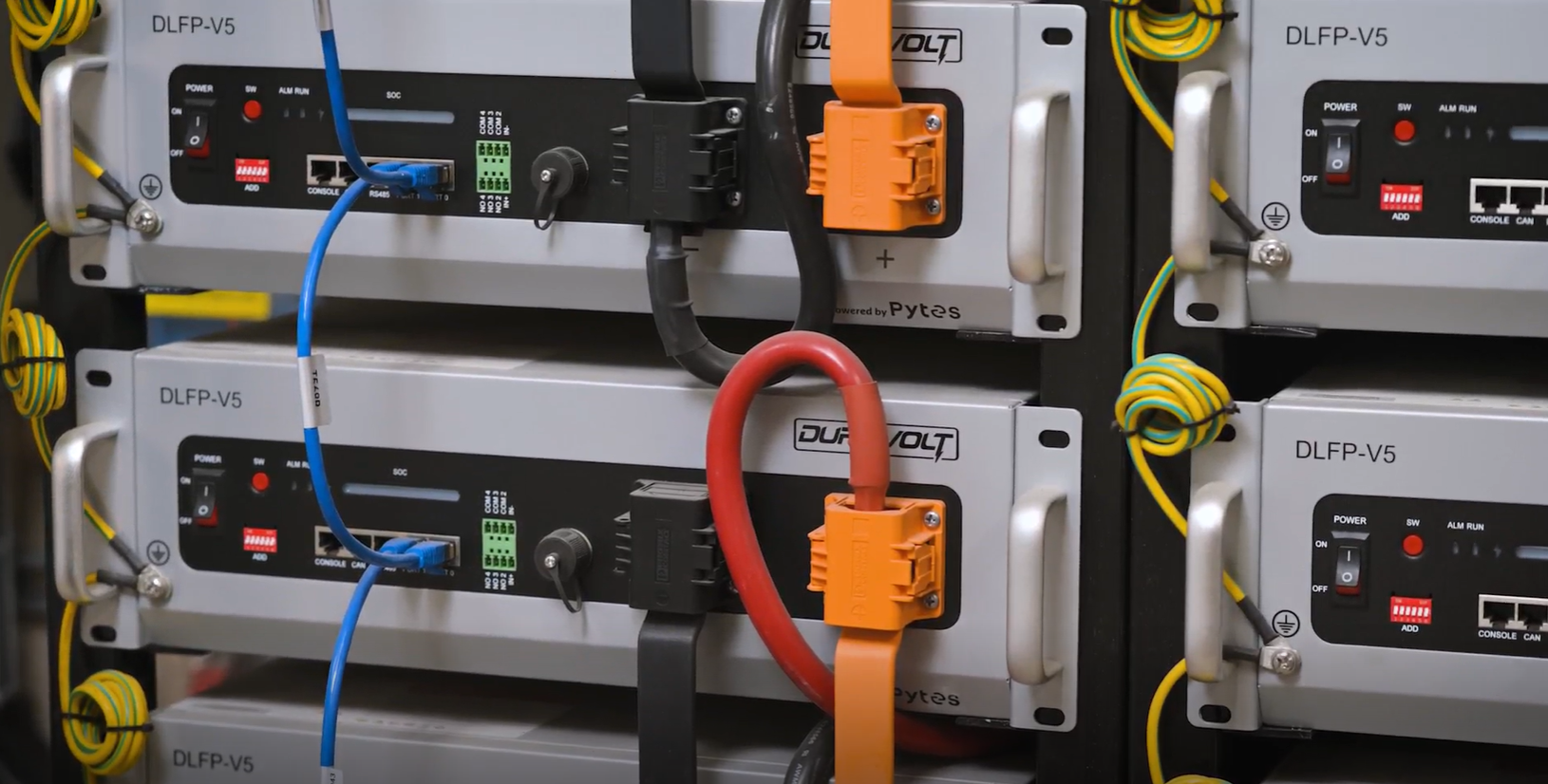
The battery bank: 36 Pytes V5 units. LFP chemistry. Up to 1C charge and discharge at maximum rated conditions.
The high-rate capability is the technical reason peak shaving works at this scale. Demand charge reduction requires the system to dispatch real power — fast — at the moment the metered peak would otherwise occur. Lower-rate platforms force oversizing the battery bank purely to meet power demand, inflating capex without adding usable energy. The V5 lets installed capacity dispatch when the peak window opens.
Behind the cells: a battery management system developed across nearly 20 years of BMS engineering experience. Component selection at the manufacturing stage prioritizes proven longevity — a discipline that compounds over the asset's operating life when the system is cycled aggressively for daily peak shaving.
The dispatch layer is built on Node-RED, with PID control logic governing system behavior in real time. The system learns from the client's consumption behavior and adapts the discharge profile accordingly — not executing a fixed daily schedule, but responding to actual production load as it evolves.
Operators define peak-window boundaries, ramp curves, and dispatch parameters. The control layer handles the rest, adjusting discharge rates dynamically to flatten the metered peak whether production runs at 80% or 100% of nominal that day.
In peak shaving applications, this adaptability matters. A static system protects against the average peak. An adaptive system protects against the actual peak — every billing cycle.
“The level of programming we can do with this equipment goes beyond anything else on the market. We can define schedules, build ramp-up and ramp-down curves, and customize the system to behave dynamically through PID control on Node-RED. That gives the system the robustness it needs in a mission-critical setup — because if it fails for a day, you lose the benefit of the whole month.”
— KDS Energía Eficiente
The system was deployed into space the client was not productively using. No dedicated battery room. No facility expansion. The compact wall-mount form factor of the V5 and the modularity of the Victron Quattro platform made it possible to integrate 9 inverters and 36 batteries into the available envelope without compromising serviceability or thermal management.
Specifying batteries at industrial scale is a different decision from specifying them for residential. The criteria that mattered:
1) High-rate charge and discharge. Up to 1C, validated for peak shaving duty cycles where real power matters as much as stored energy.
2) BMS engineering depth. Nearly two decades of battery management development behind the platform. In commercial cycling — daily peak shaving means hundreds of full cycles per year — BMS quality is the variable that determines whether the asset hits its projected lifecycle.
3) Manufacturing discipline. Components selected during manufacturing for proven longevity, not assembled to a price point.
4) Local distribution and support. Through Battery Depot's distribution in Mexico, the system is locally serviceable — with manufacturer support behind both the integrator and the end client throughout the operating life.
“We've worked hand-in-hand with the KDS team. That support extends to the end client — whatever issue they face, they have us standing behind the brand. It's an integrated package that makes us ideal for this type of project.”
— Pytes
The system performs the dual strategy it was designed to execute: shaving peak demand at the metered point while arbitraging energy across the tariff windows.
For the client, that translates to:
1)Direct production cost reduction — peak demand and peak energy procurement displaced by stored energy charged at off-peak rates
2)Predictable energy budgeting — demand charge volatility flattened by the storage layer
3)Competitive positioning — lower energy input cost enables more aggressive product pricing4)First-mover advantage — in a Mexican industrial segment where C&I storage adoption is still emerging, early deployment establishes a structural cost advantage competitors must invest to match
“In this industry, companies haven't advanced much in this area. I want to be among the first to move forward with this system.”
— Client

This deployment establishes a reference architecture for industrial peak shaving in the Mexican C&I market within the Pytes + Victron ecosystem:
1) 135 kW three-phase scalability — proven at 9 × Quattro 15 kVA configuration
2) 36-unit V5 battery bank — verified under daily peak shaving duty
3) Adaptive dispatch via Node-RED — deployable control pattern, not bespoke engineering
4) Up to 90% demand charge reduction — measured outcome at a 24/7 manufacturing site
5) Space-efficient retrofit — viable for sites without dedicated battery infrastructureFor integrators evaluating C&I storage architectures in Mexico and across Latin America, this project demonstrates that industrial-grade peak shaving and energy arbitrage do not require utility-scale infrastructure or custom engineering. The components, the control layer, and the integrator playbook exist today.
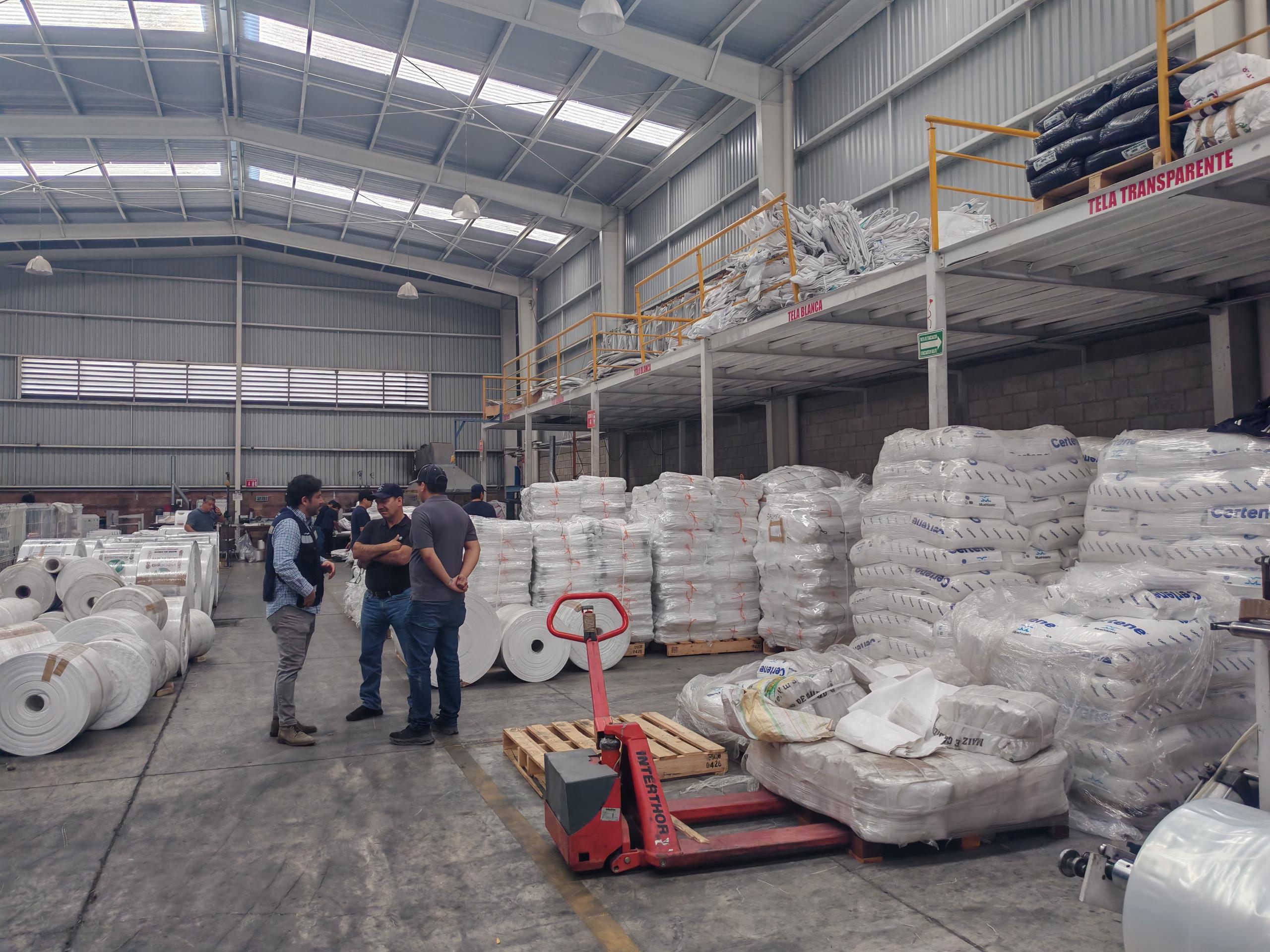
Engineered energy solutions for industrial and commercial operators in Mexico. Specializing in load profile analysis, storage system design, and customized control architectures that translate energy strategy into competitive advantage.
Distribution partner for advanced LFP storage solutions in the Mexican market.
LFP battery systems for residential, commercial, and industrial energy storage. Nearly 20 years of BMS engineering experience. Deployed across the U.S. and Latin America in partnership with leading hybrid inverter platforms.