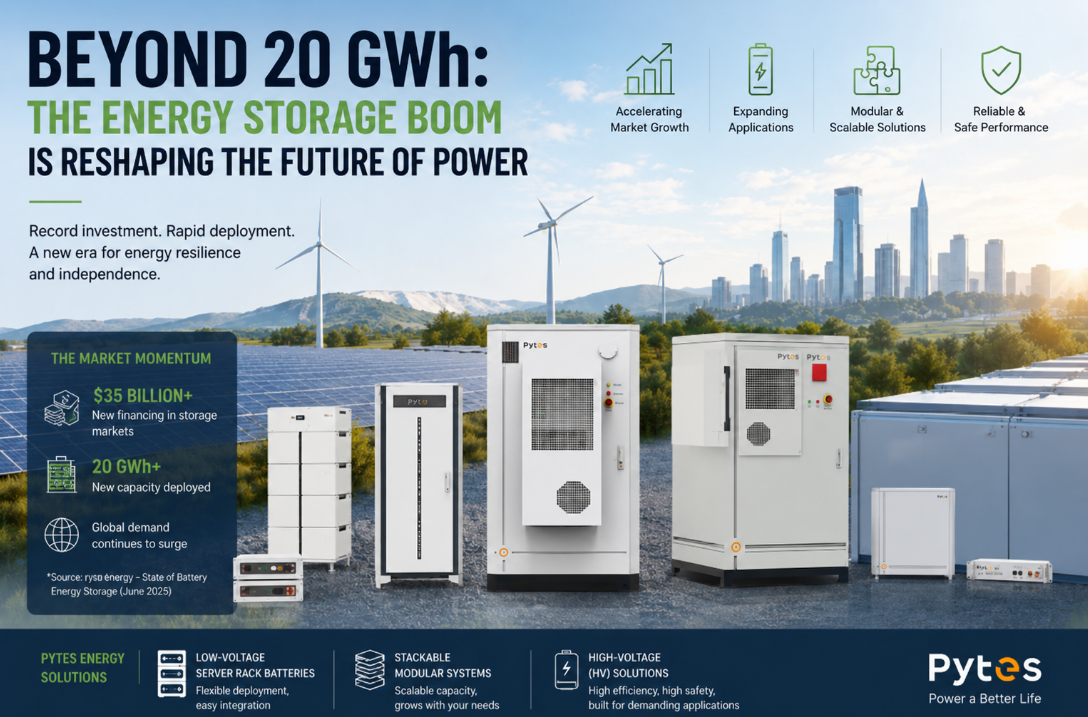
The global energy storage industry is entering a period of unprecedented expansion. Recent market data shows that billions of dollars continue to flow into battery energy storage projects, while newly commissioned capacity is reaching record levels across North America, Europe, Asia, and emerging markets. As utilities, businesses, and homeowners seek greater energy resilience and flexibility, energy storage is rapidly evolving from a complementary technology into a critical pillar of modern power infrastructure.
The momentum behind this transformation is being driven by several converging factors. Renewable energy penetration continues to increase worldwide, creating greater demand for flexible resources capable of balancing intermittent generation. At the same time, the rapid development of AI data centers, electric vehicle charging networks, and electrified industrial processes is placing additional pressure on power grids. As a result, energy storage systems are increasingly viewed as a practical solution for improving grid stability, reducing peak demand, and ensuring reliable power supply during periods of high consumption.
For years, discussions about battery energy storage focused primarily on utility-scale projects. While grid-scale storage remains one of the fastest-growing segments of the market, the industry is now expanding across multiple application scenarios. Commercial and industrial users are deploying battery systems to reduce peak demand charges, improve power quality, and support sustainability initiatives. Residential customers are also adopting energy storage at an accelerating pace, particularly in regions where electricity prices are rising or grid reliability concerns are becoming more frequent.
This diversification of demand is changing how energy storage systems are designed and deployed. End users increasingly expect solutions that are scalable, easy to install, and capable of integrating with renewable energy sources such as rooftop solar systems. Rather than purchasing oversized systems to meet future requirements, many customers prefer modular solutions that can grow alongside their energy needs.
One of the most noticeable developments in the storage sector is the growing preference for modular battery architectures. Traditional energy storage systems often required significant upfront investment and complex installation procedures. Modern modular designs offer a more flexible approach, allowing users to start with a smaller capacity and expand the system as demand increases.
For residential and commercial applications, this flexibility provides several advantages. Installation becomes simpler, transportation costs can be reduced, and maintenance is often more convenient. More importantly, modular systems help customers optimize capital expenditure by matching storage capacity to actual energy consumption rather than projected future demand.
Recognizing these market trends, Pytes Energy has focused on developing storage solutions that combine flexibility with long-term reliability. Its portfolio includes low-voltage server rack batteries, stackable modular battery systems, and high-voltage energy storage solutions designed to support both residential and commercial energy applications. By emphasizing seamless installation and user-friendly system architecture, Pytes helps customers adopt energy storage without the complexity traditionally associated with large-scale battery deployments.
Beyond economic considerations, energy independence has become one of the strongest drivers of storage adoption. Homeowners increasingly want protection against power outages and electricity price fluctuations. Businesses seek greater control over energy costs while ensuring uninterrupted operations. In both cases, battery storage is enabling users to manage energy more proactively.
Modern energy systems are no longer limited to simple electricity consumption. Instead, many facilities are creating integrated energy ecosystems that combine solar generation, battery storage, and intelligent energy management technologies. This approach allows users to store excess energy when production exceeds demand and utilize stored energy during peak periods or grid interruptions.
For companies operating in competitive markets, reliable power availability can directly impact productivity and profitability. As a result, investment in energy storage is increasingly viewed not merely as a sustainability initiative but as a strategic business decision.
While battery prices have declined significantly over the past decade, future market growth will likely be driven by factors beyond cost reduction alone. Safety, lifecycle performance, installation efficiency, and system scalability are becoming increasingly important purchasing criteria. Customers are looking for solutions that deliver long-term value rather than simply the lowest initial investment.
Manufacturers that can address these evolving requirements will be well positioned as the market continues to mature. This includes not only improving battery technology itself but also enhancing the overall user experience through simplified installation, intelligent monitoring, and flexible system design.
Pytes Energy's continued investment in advanced battery solutions reflects this broader industry direction. As energy storage becomes a mainstream component of residential and commercial power infrastructure, solutions that balance performance, reliability, and ease of deployment will play an increasingly important role in market adoption.
The latest wave of investment and deployment activity demonstrates that energy storage is entering a new stage of development. What was once considered an emerging technology is now becoming an essential part of modern energy systems. From grid-scale installations supporting renewable integration to residential battery systems enhancing energy independence, storage is reshaping how electricity is generated, managed, and consumed.
As demand continues to grow across multiple sectors, the companies that succeed will be those capable of delivering practical, scalable, and reliable solutions. With a product portfolio designed around flexibility, seamless integration, and user experience, Pytes Energy is helping homes and businesses navigate this transition and move toward a more resilient and sustainable energy future.