The global energy storage industry has officially crossed a major milestone. According to BloombergNEF’s latest Energy Storage Market Outlook, annual deployments have surpassed 100GW for the first time, reaching around 112GW and more than 300GWh of installed capacity in 2025. Forecasts indicate continued rapid expansion, with 2026 expected to approach 158GW and nearly 459GWh of new installations.
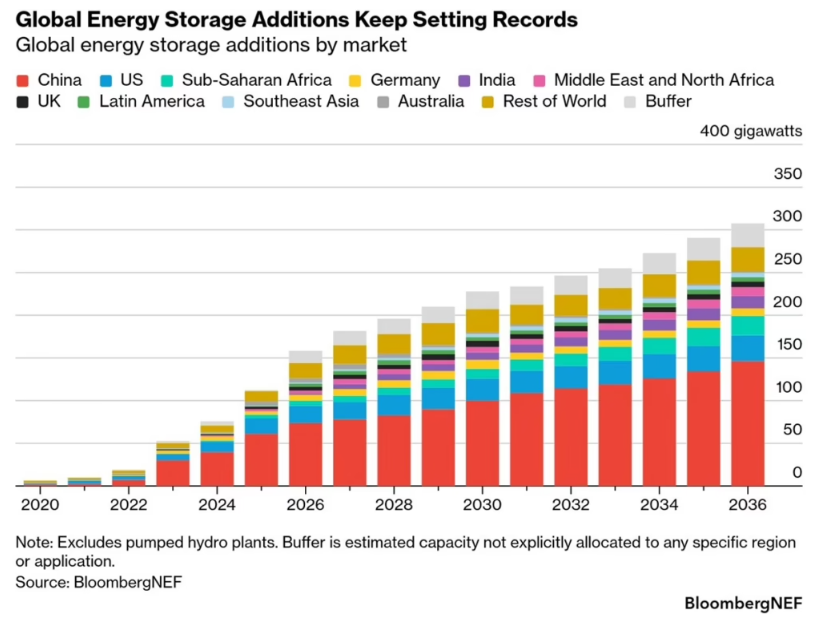
This shift is more than a statistical record. It reflects a structural change in how electricity systems are being designed, operated, and expanded. Energy storage is no longer a supporting technology for renewables—it is becoming a core pillar of modern grid infrastructure.
Across utility-scale projects, commercial installations, and residential systems, the demand for flexible and reliable storage solutions is accelerating. The drivers are consistent across regions: increasing renewable penetration, grid congestion, rising electricity prices, and the rapid electrification of transport and industrial systems.
In this environment, battery storage is evolving from a project add-on into a strategic asset.
A few years ago, energy storage was primarily deployed as a complement to solar or wind installations. It helped smooth intermittent output and provided limited backup capability. Today, that role has fundamentally changed.
With renewable generation becoming a dominant share of new capacity additions in many countries, grid operators are facing new challenges in balancing supply and demand. Solar-heavy grids experience midday oversupply and evening deficits. Wind power introduces additional variability. At the same time, peak electricity demand is increasing due to electric vehicles, data centers, and electrified heating systems.
Energy storage is now being deployed to solve these structural issues at scale. Instead of simply supporting renewables, it is actively stabilizing power systems.
This is one of the key reasons behind the rapid acceleration past the 100GW threshold.
While large grid-scale battery systems continue to dominate total installed capacity, distributed storage—covering residential and commercial applications—is growing rapidly.
The reason is straightforward: energy control is shifting closer to the end user.
Businesses want to manage peak demand charges, reduce exposure to volatile electricity pricing, and ensure uninterrupted operations during grid instability. Homeowners increasingly seek energy independence, particularly in regions with frequent outages or high retail electricity costs.
In both cases, storage provides a practical solution by shifting energy consumption from peak periods to off-peak or self-generated periods.
This shift is creating strong demand for systems that are not only efficient but also modular, scalable, and easy to integrate with solar PV and existing electrical infrastructure.
One of the defining trends behind the 100GW storage era is the dominance of Lithium Iron Phosphate (LFP) battery technology.
LFP chemistry is now widely preferred for stationary storage due to its thermal stability, long cycle life, and improved safety profile compared to traditional nickel-based chemistries. It also delivers strong cost competitiveness at scale, which is critical for both residential and commercial deployment models.
As system lifetimes extend and storage becomes a long-term infrastructure investment, reliability and safety are becoming more important than marginal energy density improvements.
This has helped LFP become the standard foundation for most modern storage systems deployed globally.
As the storage market matures, system integration is becoming as important as battery performance itself.
Modern energy storage systems are no longer just battery packs. They are integrated solutions that include battery modules, battery management systems (BMS), power conversion systems (PCS), thermal management, and monitoring software.
The focus has shifted toward:
· Easier installation and commissioning
· Modular expansion capability
· Stable long-term performance
· Seamless compatibility with solar and hybrid inverters
· Improved user-side energy management
This is especially important in residential and distributed commercial systems, where installation time and system complexity directly impact adoption rates.
As the global energy storage market expands into the 100GW era, system reliability and deployment flexibility are becoming critical competitive factors.
Pytes Energy has positioned itself around these requirements, focusing on delivering practical, application-ready storage solutions designed for real-world installation environments.
The company’s product portfolio includes low-voltage server rack batteries, stackable modular systems, and high-voltage storage solutions designed for larger residential and commercial applications. Each system is engineered with a focus on installation simplicity, long cycle performance, and compatibility with mainstream inverter ecosystems.
Rather than optimizing only for technical specifications, the emphasis is placed on deployment efficiency and long-term usability—two factors that increasingly define success in the distributed storage market.
As global demand continues to grow, this type of system-oriented approach becomes increasingly relevant for installers and end users looking for reliable, scalable energy solutions.
One interesting development in the current market cycle is the convergence between residential and small commercial storage systems.
In the past, these segments were clearly separated by scale and technical complexity. Today, the boundary is becoming less distinct. Many commercial users now deploy modular systems that closely resemble residential architectures but are scaled for higher capacity.
This convergence is driving demand for flexible battery platforms that can serve multiple use cases without requiring fundamentally different system architectures.
Modularity and compatibility are becoming key purchasing considerations, especially for distributed energy projects that anticipate future expansion.
Looking ahead, the next phase of energy storage growth is expected to be driven less by standalone battery deployment and more by system integration.
Storage will increasingly be embedded within:
· Solar-plus-storage installations
· Microgrid systems
· Virtual power plants
· Smart energy management platforms
This integration will require tighter coordination between hardware and software, as well as improved interoperability across devices and energy ecosystems.As storage moves deeper into mainstream energy infrastructure, user experience, installation efficiency, and system intelligence will become as important as raw capacity.
The crossing of the 100GW annual deployment threshold marks a clear turning point for the global energy storage industry. What was once an emerging technology has now become a foundational component of modern power systems.
Growth is being driven by structural changes in energy generation, consumption, and grid operation. At the same time, technological maturity—particularly in LFP-based systems—is enabling safer, more cost-effective deployment across residential, commercial, and utility-scale applications.
Companies like Pytes Energy are operating within this transition by focusing on scalable, modular, and application-ready storage systems that align with real-world deployment needs.
As the market continues to expand, energy storage is no longer just about storing electricity. It is about enabling flexibility, resilience, and energy independence in a rapidly changing global power landscape.