In today’s distributed energy landscape, storage systems are expected to do far more than simply store electricity. They must deliver stable output, integrate seamlessly with solar inverters, support high peak loads, and remain reliable over long operating lifecycles. This is exactly where the Pytes V5 5.12kWh LFP battery is positioned—serving as a standardized, modular building block for residential and light commercial energy storage systems.
Built on a 51.2V 100Ah LiFePO4 platform, the V5 reflects a design philosophy focused on safety, scalability, and real-world usability rather than purely theoretical specifications.
The foundation of the V5 is a 51.2V nominal voltage architecture, which has become one of the most widely adopted standards in modern low-voltage energy storage systems.
Each module provides:
· 5.12kWh nominal energy
· 100Ah capacity
· 51.2V nominal voltage
· Operating range approximately 47.5V to 57.6V
This voltage level is particularly important because it aligns with most hybrid inverter systems used in residential and small commercial installations. The result is lower conversion loss compared with smaller voltage systems and smoother integration across different ESS configurations.
In practical terms, this means fewer compatibility issues during installation and more stable system performance under varying load conditions.
Energy storage systems rarely operate under constant load. Instead, they must handle sudden surges such as compressor starts, pump activation, or HVAC cycling.
The Pytes V5 is engineered to support these conditions with robust discharge performance:
· Recommended continuous charge/discharge current: 75A
· Maximum continuous current: 100A
· Peak discharge capability up to 120–180A (short duration depending on conditions)
This level of output allows a single 5.12kWh module to support demanding appliances without immediate oversizing of the entire battery bank.
For system designers, this flexibility translates into more efficient system sizing, especially in applications where short-term power demand is significantly higher than average consumption.
The V5 uses Lithium Iron Phosphate (LFP) chemistry, which has become the dominant choice in stationary energy storage due to its stability and long service life.
Key lifecycle characteristics include:
· More than 6000 cycles at high depth of discharge
· Long operational lifespan typically exceeding 10 years in daily cycling applications
· High thermal stability and reduced risk of thermal runaway
Compared with alternative lithium chemistries, LFP offers a more balanced trade-off between safety, cost, and longevity. This is particularly important for residential and distributed storage systems where long-term reliability directly impacts return on investment.
Energy storage systems are deployed across a wide range of environmental conditions, from cold northern climates to hot tropical regions.
The V5 is designed to operate within:
· Discharge temperature range: -10°C to 50°C
This wide operating envelope ensures stable performance across different geographic regions without requiring complex external thermal management systems in most residential installations.
In colder environments, the system maintains usability for discharge operations, which is critical for backup power applications during winter outages.
One of the key advantages of the Pytes V5 platform is its modular design approach.
Instead of relying on a single large battery, the system is built around stackable 5.12kWh units, allowing flexible expansion based on demand.
Typical system configurations include:
· Residential systems: 10–20kWh
· Light commercial systems: 20–80kWh
· Larger distributed systems: 100 kWh and above via multi-cluster expansion, scalable up to 491.52 kWh.
This modularity reduces initial investment pressure while allowing gradual system expansion as energy needs increase.
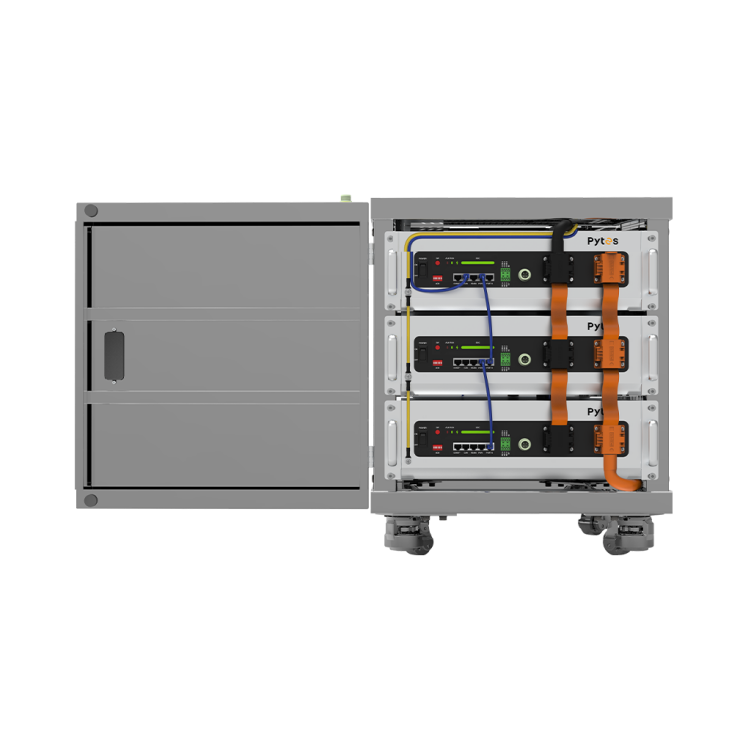
The V5 adopts a standardized rack-mounted structure designed for ESS cabinet integration.
Each unit features:
· Compact enclosure optimized for stacking
· Weight of approximately 44kg per module
· Standardized mechanical compatibility with rack systems
This design significantly simplifies installation and reduces commissioning time. In multi-module systems, pre-designed rack layouts allow installers to deploy storage systems faster and with fewer configuration errors.
Standardization also improves compatibility with widely used inverter brands and energy storage cabinets.
Modern energy systems require more than electrical performance—they require data visibility and control integration.
The Pytes V5 supports:
· CAN communication
· RS485 communication
These interfaces allow seamless integration with:
· Hybrid solar inverters
· Energy management systems (EMS)
· Monitoring and control platforms
Real-time data such as state of charge, voltage, temperature, and system status enables better energy optimization and predictive maintenance strategies.
This level of integration is particularly important in systems where multiple battery modules operate in parallel.
The V5 is widely applicable across different energy storage use cases.
In residential solar systems, it enables self-consumption optimization by storing excess daytime solar generation for nighttime use. It also provides reliable backup power during grid outages.
In commercial applications, it supports peak shaving strategies, helping reduce electricity costs during high tariff periods.
In off-grid and hybrid systems, the strong discharge capability ensures stable operation of critical loads such as refrigeration, water pumps, and communication systems.
The flexibility of a single platform across multiple applications simplifies system design and inventory management for installers and integrators.
Beyond individual specifications, the Pytes V5 reflects a system-oriented design approach.
Instead of focusing only on battery performance, the platform emphasizes:
· Installation efficiency
· System scalability
· Long-term reliability
· Compatibility with mainstream ESS architectures
This makes it suitable not only as a standalone battery module but as part of a larger energy ecosystem that includes inverters, monitoring systems, and distributed storage networks.
The Pytes V5 5.12kWh LFP battery represents a balanced approach to modern energy storage design, combining stable 51.2V architecture, strong discharge capability, long cycle life, and modular scalability.
Its ability to scale from small residential systems to larger distributed energy installations makes it a versatile foundation for a wide range of applications.
As energy storage continues to move toward modular, distributed, and intelligent system architectures, solutions like the V5 are becoming core building blocks for reliable and flexible energy infrastructure.