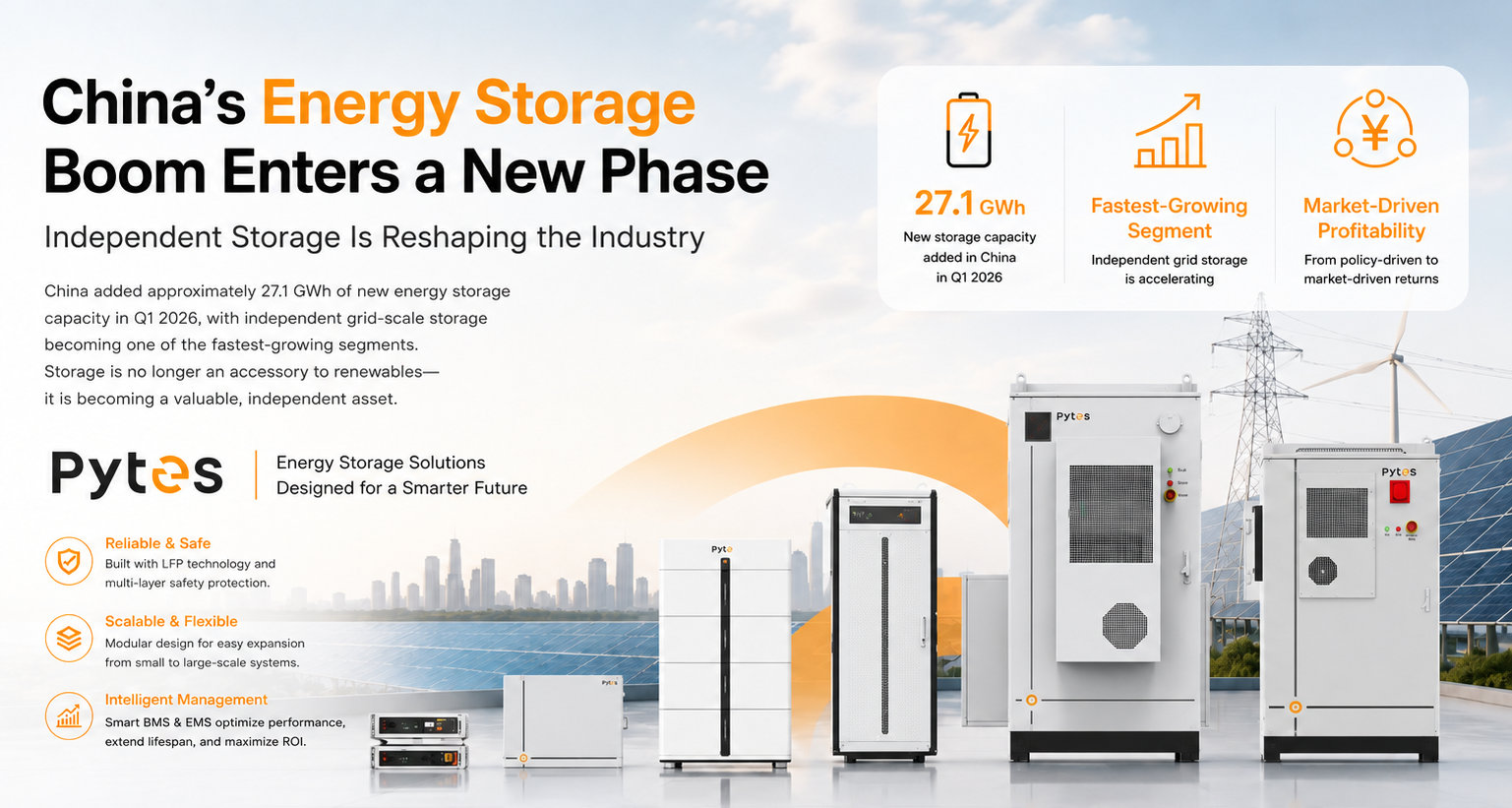
China's energy storage industry is entering a decisive turning point. For years, battery energy storage systems (BESS) were primarily deployed alongside solar and wind farms as supporting infrastructure, often driven by policy requirements rather than market economics. However, the situation is changing rapidly. According to recent industry reports, China added more than 27 GWh of new energy storage capacity in the first quarter of 2026, with independent grid-scale storage emerging as one of the fastest-growing sectors. Instead of serving merely as an accessory to renewable generation, storage is now becoming an independent profit-generating asset capable of participating in electricity trading, peak shaving, frequency regulation, and ancillary grid services.
This transformation reflects a deeper evolution of the energy market. As China's electricity spot markets mature and pricing mechanisms become more market-oriented, investors are beginning to evaluate storage projects differently. Installed capacity is no longer the only metric that matters. The ability to cycle efficiently, respond quickly to grid demands, maximize asset utilization, and deliver long-term returns has become equally important. Independent storage projects are therefore attracting increasing attention because they provide operators with more flexibility to optimize charging and discharging strategies based on real-time electricity prices and grid requirements.
For technology providers, this shift creates both opportunities and challenges. Battery manufacturers can no longer rely solely on offering cells or hardware. Customers are demanding complete energy storage ecosystems that integrate battery technology, intelligent energy management, safety systems, and scalable architectures. This is exactly where companies such as Pytes Energy are focusing their efforts.
Over the years, Pytes has established itself as a trusted energy storage brand by developing solutions designed around the practical needs of residential and commercial users. Its portfolio covers low-voltage server rack batteries, stackable modular systems, and high-voltage (HV) energy storage solutions. Rather than pursuing complexity, Pytes emphasizes easy installation, flexible expansion, and reliable long-term operation. These characteristics are becoming increasingly valuable as the industry moves toward more decentralized and intelligent energy systems.
The growing popularity of independent storage is also influencing residential and commercial markets. Homeowners with rooftop solar systems are looking for ways to maximize self-consumption and secure backup power during outages, while businesses seek to reduce peak electricity costs and improve operational resilience. Energy storage is gradually evolving from a backup solution into a core component of energy independence. In this context, modular systems capable of scaling from small residential applications to larger commercial projects are attracting strong market interest.
At the same time, software is becoming as important as hardware. Modern energy storage systems are expected to do far more than store electricity. Intelligent energy management systems can analyze electricity prices, predict energy demand, optimize charging schedules, and monitor battery health in real time. Artificial intelligence is beginning to enhance these capabilities further, allowing storage assets to make smarter operational decisions and improve overall economic performance. The future competition in energy storage may therefore depend not only on battery chemistry or capacity but also on how intelligently the system can operate.
China's transition toward independent energy storage is likely to have global implications. The country's market has long served as an indicator of broader industry trends, and its latest shift suggests that energy storage is moving beyond policy-driven growth into an era defined by profitability, technological innovation, and operational efficiency. Companies capable of delivering reliable, scalable, and intelligent solutions will be better positioned to capture the next wave of opportunities.
For Pytes Energy, this transition aligns closely with its long-term vision. By combining dependable battery technologies with user-friendly designs and scalable architectures, the company aims to help homes and businesses achieve greater energy independence while supporting a more sustainable energy future. As independent storage continues to expand, energy storage itself is no longer just supporting the grid—it is increasingly becoming one of the grid's most valuable and dynamic assets.