The U.S. energy storage industry has reached another significant milestone. According to the latest market data released by Wood Mackenzie and the American Clean Power Association, the United States deployed a record-breaking amount of battery energy storage capacity during the first quarter of 2026. The results exceeded many industry expectations and reinforced a trend that has been building for several years: energy storage is no longer a supporting technology for renewable energy—it is becoming a critical pillar of modern power infrastructure.
For homeowners, businesses, utilities, and energy solution providers, this market acceleration signals a fundamental shift in how electricity is generated, stored, and consumed. It also highlights why companies such as Pytes Energy continue to invest in advanced battery technologies that help customers achieve greater energy resilience, energy independence, and long-term sustainability.
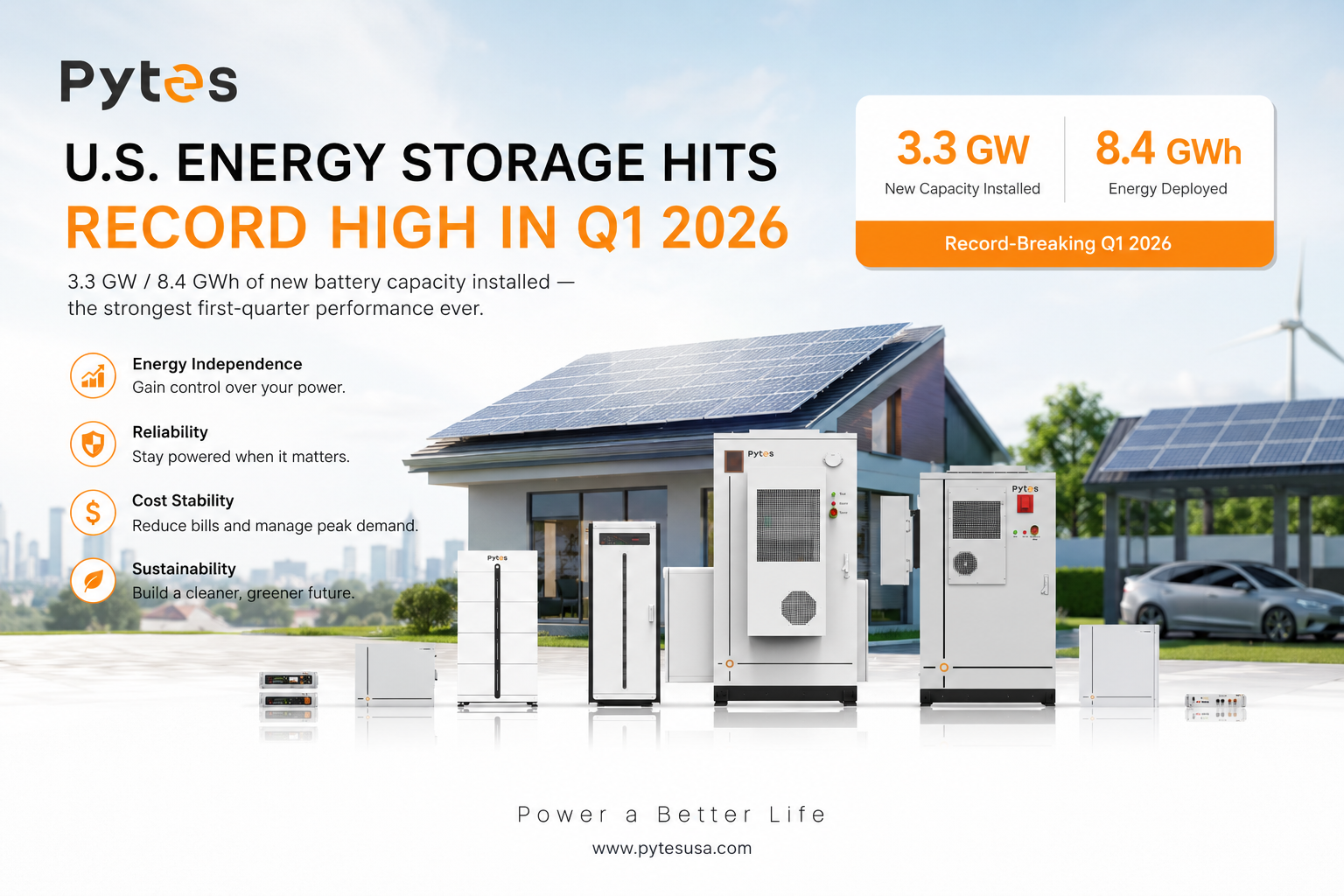
The U.S. energy storage market installed approximately 3.3 GW and 8.4 GWh of new battery capacity during the first quarter of 2026, marking the strongest first-quarter performance ever recorded in the country.
Historically, energy storage deployments have been concentrated in the second half of the year as developers race to complete projects before annual deadlines. The fact that Q1 alone reached record levels demonstrates how rapidly demand is expanding across multiple sectors.
Several factors contributed to this growth. Utility-scale projects continue to dominate deployment volumes as grid operators seek greater flexibility to manage renewable energy generation. At the same time, commercial and residential customers are increasingly adopting battery storage to reduce electricity costs, improve backup power capabilities, and gain more control over energy consumption.
The growth also reflects a broader recognition that energy storage is essential for maintaining grid reliability in a power system increasingly dependent on solar and wind resources.
One of the most important drivers behind recent deployment activity is the evolving regulatory landscape.
Developers are moving quickly to secure project approvals and begin construction before potential policy changes affect incentive programs, tax credits, and grid interconnection rules. While regulations continue to evolve, the market response has been clear: energy storage remains one of the most attractive infrastructure investments available today.
This urgency is not limited to utility-scale projects. Businesses are increasingly evaluating battery systems as part of long-term energy strategies, particularly in regions experiencing rising electricity prices or grid reliability concerns.
The ability to store electricity during off-peak periods and utilize it during peak demand events provides both economic and operational benefits. As a result, energy storage is becoming a strategic asset rather than simply an energy management tool.
The rapid growth of battery storage reflects a changing mindset among energy consumers.
For decades, electricity users relied almost entirely on centralized utility networks. Today, a growing number of households and businesses are seeking greater control over their energy resources. Solar generation combined with battery storage offers an effective pathway toward this goal.
Energy independence is no longer viewed solely as a sustainability objective. It is increasingly associated with reliability, resilience, and cost stability.
Extreme weather events, aging grid infrastructure, and fluctuating electricity prices have demonstrated the value of having locally stored energy available when needed. Battery systems enable customers to maintain critical operations during outages while reducing dependence on unpredictable utility pricing structures.
This trend is driving demand for flexible storage solutions that can adapt to different applications and future energy needs.
Although utility-scale projects account for most installed capacity, the residential and commercial sectors represent some of the fastest-growing segments of the market.
Homeowners are increasingly pairing rooftop solar systems with battery storage to maximize self-consumption and reduce reliance on the grid. Businesses are deploying storage systems to manage peak demand charges, improve energy security, and support sustainability initiatives.
The growing adoption of electric vehicles, smart home technologies, and distributed renewable generation is creating additional opportunities for battery storage integration.
These market developments align closely with the mission of Pytes Energy. As a trusted brand in the energy storage industry, Pytes develops solutions specifically designed to address the evolving needs of modern energy users.
Its product portfolio includes low-voltage server rack batteries, modular stackable battery systems, and high-voltage energy storage solutions that support both residential and commercial applications. Designed with installation simplicity, scalability, and user experience in mind, Pytes solutions help customers build reliable energy storage systems that can grow alongside future energy demands.
The rapid expansion of energy storage would not be possible without significant advances in battery technology.
Over the past decade, lithium iron phosphate (LFP) batteries have become the preferred chemistry for many storage applications due to their safety, cycle life, thermal stability, and cost effectiveness. Improvements in battery management systems, inverter integration, and intelligent monitoring platforms have further enhanced system reliability and operational performance.
Today's storage systems are capable of delivering thousands of charge-discharge cycles while maintaining high levels of efficiency. These improvements have strengthened investor confidence and accelerated adoption across residential, commercial, and utility markets.
Manufacturers that focus on product reliability, installation flexibility, and long-term performance are particularly well positioned to benefit from the next phase of market growth.
Pytes continues to invest in product innovation aimed at helping customers maximize the value of their energy storage investments. By offering scalable architectures and user-friendly system designs, the company supports a wide range of energy independence goals, from backup power applications to fully integrated solar-plus-storage solutions.
Industry analysts expect the U.S. energy storage market to maintain strong momentum throughout the remainder of the decade. Increasing renewable energy penetration, expanding electrification, growing data center demand, and continued grid modernization efforts are all expected to drive additional storage deployments.
At the same time, energy storage is evolving beyond traditional backup applications. Batteries are becoming active participants in energy markets, providing services such as peak shaving, demand response, frequency regulation, and virtual power plant participation.
This transformation creates new opportunities for both energy consumers and storage providers. Companies capable of delivering reliable, scalable, and future-ready solutions will play an increasingly important role in supporting the global energy transition.
The record-breaking performance of the U.S. energy storage market in the first quarter of 2026 highlights a powerful reality: energy storage has become an essential component of modern energy infrastructure.
As regulatory changes, grid challenges, and energy independence goals continue to reshape the market, demand for advanced battery solutions is expected to accelerate across residential, commercial, and utility sectors.
For companies like Pytes Energy, this market growth represents more than an industry milestone. It reflects a broader movement toward a future where individuals and businesses have greater control over their energy resources. Through innovative storage technologies and customer-focused solutions, Pytes is helping make that future more accessible, reliable, and sustainable than ever before.