The U.S. battery energy storage system (BESS) market is entering a new stage of development. As renewable energy deployment accelerates, electricity demand from data centers continues to rise, and grid flexibility becomes increasingly important, energy storage manufacturers are shifting their focus from simply increasing battery capacity to building reliable, scalable, and locally supported energy solutions.
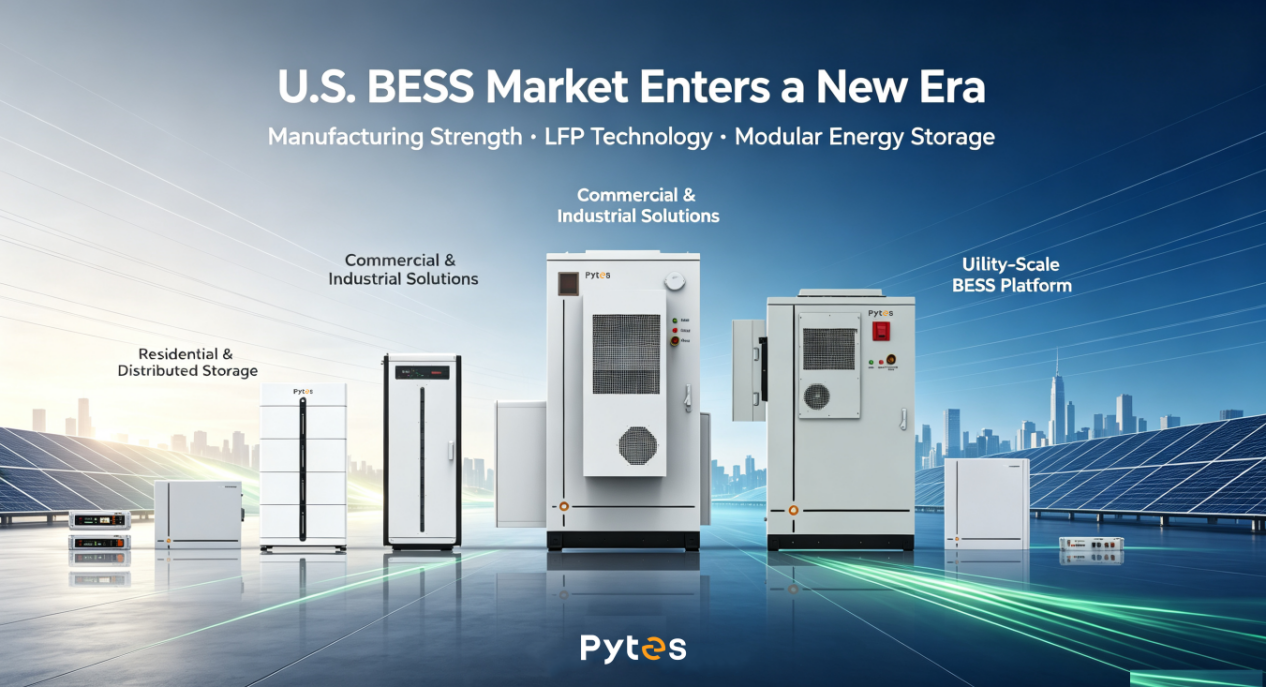
A recent move by SK On highlights this transformation. The company is leveraging its established U.S. manufacturing footprint, lithium iron phosphate (LFP) battery technology, and vertically integrated production capabilities to expand its position in the American BESS market. According to Energy-Storage.News, SK On is preparing its next-generation GridOn BESS platform, designed for utility-scale, industrial, and data center applications with flexible configurations and improved energy density.
This market shift also creates new opportunities for specialized energy storage providers such as Pytes Energy, which focuses on delivering safe, flexible, and user-oriented battery storage solutions for residential, commercial, and distributed energy applications.
For years, battery storage growth was mainly driven by reducing battery costs and expanding production capacity. However, the U.S. market is now placing greater emphasis on supply chain security, domestic manufacturing capability, and long-term system reliability.
SK On’s strategy reflects this change. The company is expanding its U.S. battery production capabilities and applying its experience from electric vehicle battery manufacturing to stationary energy storage systems. Its GridOn platform uses LFP battery technology and is designed to support different operating requirements, including renewable energy integration, industrial power management, and data center backup applications.
This development shows that the future competition in the BESS industry will not only depend on battery chemistry or price. Manufacturers must also demonstrate:
· Stable production capability
· Reliable supply chains
· Advanced safety technologies
· Flexible system integration
For energy storage customers, the value of a battery system is increasingly measured by its complete lifecycle performance rather than initial equipment cost.
Lithium iron phosphate (LFP) batteries have become one of the dominant technologies in the stationary energy storage market because of their balance between safety, cycle life, and cost efficiency.
Compared with other lithium battery chemistries, LFP offers advantages including:
· Higher thermal stability
· Longer cycle life
· Lower risk under high-temperature operation
· Better suitability for frequent charge and discharge cycles
These characteristics make LFP particularly suitable for applications where batteries operate daily for many years, such as solar energy storage, peak shaving, backup power, and microgrid systems.
SK On’s entry into the U.S. stationary storage market with LFP-based solutions reflects the broader industry trend toward safer and more durable energy storage systems. The company has also secured a large-scale supply agreement with Flatiron Energy, covering up to 7.2GWh of BESS supply through 2030.
As battery storage projects become larger and more widely deployed, safety management has become a critical factor.
Modern BESS solutions must address:
· Thermal management
· Battery monitoring
· Fault detection
· System-level protection
SK On’s next-generation GridOn platform introduces advanced safety features, including early abnormality detection technology connected with battery management systems. These technologies aim to identify potential issues earlier and improve operational reliability.
For distributed energy storage systems, safety is equally important. Homeowners and businesses require solutions that can operate reliably in daily environments without complex maintenance.
This is where Pytes Energy continues to develop practical energy storage solutions. Pytes designs battery systems with installation simplicity, safety performance, and user experience as key priorities. Its product portfolio covers:
· Low-voltage server rack batteries
· Stackable modular battery systems
· High-voltage (HV) energy storage solutions
These solutions are designed to support different application scenarios, from residential solar storage to commercial energy management.
While utility-scale BESS projects attract significant attention, distributed energy storage is also becoming an important part of the energy transition.
Households and businesses are increasingly looking for ways to:
· Reduce dependence on the grid
· Improve energy resilience
· Increase renewable energy utilization
· Manage electricity costs
A flexible battery system allows users to store solar energy during periods of high production and use stored power when electricity demand or prices increase.
For example, a residential solar system combined with a modular battery solution can provide backup power during outages while improving renewable energy self-consumption.
Commercial users can also benefit from energy storage through:
· Peak demand reduction
· Backup power support
· Load management
· Renewable energy optimization
Pytes Energy focuses on making energy storage more accessible by providing modular solutions that simplify installation and expansion.
One of the major trends in modern battery storage is modular architecture.
Traditional energy storage systems often require complex installation and significant engineering support. Modular systems provide greater flexibility by allowing users to expand capacity according to future energy needs.
Advantages of modular battery systems include:
· Easier installation
· Flexible capacity expansion
· Lower initial investment
· Simplified maintenance
Pytes’ stackable modular battery solutions are designed around this concept. Instead of requiring a complete system replacement when energy demand increases, users can expand storage capacity based on actual requirements.
This approach is particularly valuable for residential and small commercial projects where energy consumption patterns may change over time.
The evolution of the U.S. BESS market demonstrates that energy storage is becoming more than a battery product. It is becoming a complete energy management solution that combines hardware reliability, safety technology, scalability, and user experience.
While companies like SK On are accelerating large-scale BESS deployment through domestic manufacturing and advanced battery platforms, distributed storage providers are helping more households and businesses participate in the clean energy transition.
As a trusted energy storage brand, Pytes Energy continues to develop solutions designed for real-world energy needs. Its product range, including low-voltage server rack batteries, stackable modular systems, and high-voltage solutions, provides customers with flexible options for achieving energy independence and sustainable power management.
By focusing on reliable battery technology, simplified installation, and adaptable system design, Pytes helps users confidently move toward a more resilient energy future.
The U.S. BESS market is entering a more mature phase where manufacturing capability, safety technology, and system flexibility will define future success.
The growth strategy demonstrated by SK On shows that large-scale energy storage requires strong supply chains, advanced battery platforms, and reliable production capacity. At the same time, the increasing demand for distributed energy solutions creates opportunities for companies that can deliver efficient and user-friendly storage systems.
With the continued expansion of renewable energy and rising demand for energy independence, solutions like those provided by Pytes Energy will play an increasingly important role in building a cleaner, smarter, and more resilient energy ecosystem.