For years, lithium-ion batteries have dominated the global energy storage market. However, the rapid expansion of AI infrastructure is reshaping industry priorities. As hyperscale data centers demand reliable, scalable, and cost-effective electricity around the clock, the conversation is no longer centered solely on battery energy density—it is increasingly about supply chain resilience, operating cost, temperature tolerance, and long-term scalability.
A recent Reuters report highlights how this shift is accelerating commercial investment in sodium-ion batteries, with automakers, battery manufacturers, and energy storage developers moving quickly to establish production capacity for the next generation of stationary storage systems.
While lithium iron phosphate (LFP) batteries will remain the mainstream technology for years to come, the emergence of sodium-ion technology signals that the future of energy storage will likely be defined by multiple battery chemistries working together rather than one replacing another.
Unlike traditional commercial facilities, AI data centers operate continuously with extremely high power density. Every interruption can translate into significant operational and financial losses, making reliable energy storage an essential part of digital infrastructure.
According to Reuters, soaring electricity demand from AI computing, cloud services, and utilities is driving unprecedented investment in battery storage systems. At the same time, automakers are redirecting underutilized EV battery production capacity toward stationary energy storage, recognizing the enormous growth potential of this market.
This trend is changing how the industry evaluates battery technologies. Rather than focusing exclusively on energy density, developers are placing greater emphasis on:
· Long service life
· Lower system cost
· Stable operation under varying temperatures
· Supply chain security
· Faster deployment for large-scale projects
These requirements create opportunities for emerging battery chemistries that complement existing lithium technologies.
Sodium-ion batteries have long been viewed as a promising alternative, but commercial adoption has been limited until recently. Several factors are now pushing the technology toward large-scale deployment.
The first is material availability. Sodium is abundant and widely distributed, reducing dependence on critical minerals associated with lithium supply chains.
The second is thermal performance. Reuters notes that sodium-ion batteries operate across a wider temperature range while requiring less cooling than conventional lithium systems, making them particularly attractive for stationary applications such as grid storage and AI data centers.
Another advantage is charging capability. Sodium-ion batteries can support rapid charging, making them suitable for peak shaving, power arbitrage, and other grid-support applications. As manufacturing scales up, analysts expect system costs to become increasingly competitive. The International Energy Agency projects sodium-ion batteries could account for around 10% of global annual energy storage additions by 2030.
The Reuters report illustrates how rapidly the market is evolving.
General Motors has announced plans to develop sodium-ion battery supply chains with Peak Energy, targeting production in Michigan by 2028. Chinese battery manufacturers continue expanding sodium-ion manufacturing capacity, while new strategic partnerships are emerging to serve utility-scale storage and data center projects.
Large commercial agreements further demonstrate growing confidence in the technology. Battery suppliers are signing multi-gigawatt-hour contracts as production transitions from pilot projects to commercial manufacturing. These developments indicate that sodium-ion batteries are moving beyond laboratory research into practical deployment.
For energy storage developers, the message is clear: diversification of battery chemistry is becoming an important strategic consideration.
Although sodium-ion technology is attracting considerable attention, lithium-based batteries continue to offer exceptional performance, mature manufacturing, and proven reliability.
For residential energy storage, commercial applications, and distributed renewable energy systems, lithium iron phosphate (LFP) technology remains the preferred choice because of its high cycle life, excellent safety profile, and established global supply chain.
Rather than viewing sodium and lithium as competing technologies, many industry experts expect them to serve complementary roles. Lithium batteries will continue powering applications requiring high energy density and mature ecosystem support, while sodium-ion batteries are likely to expand rapidly in large stationary storage projects where cost, temperature tolerance, and raw material availability become increasingly important.
While headlines often focus on utility-scale projects and AI infrastructure, these industry developments ultimately benefit residential and commercial users as well.
Growing investment in battery manufacturing accelerates innovation across the entire energy storage sector. Improvements in battery management systems, manufacturing efficiency, and supply chain capacity contribute to better products, enhanced safety, and more competitive pricing.
For homeowners seeking greater energy independence and businesses aiming to reduce electricity costs, reliable lithium-based storage systems remain the most practical solution available today.
This is where experienced manufacturers play an essential role.
As battery technologies continue to evolve, customers need solutions that deliver dependable performance today while remaining compatible with future energy ecosystems.
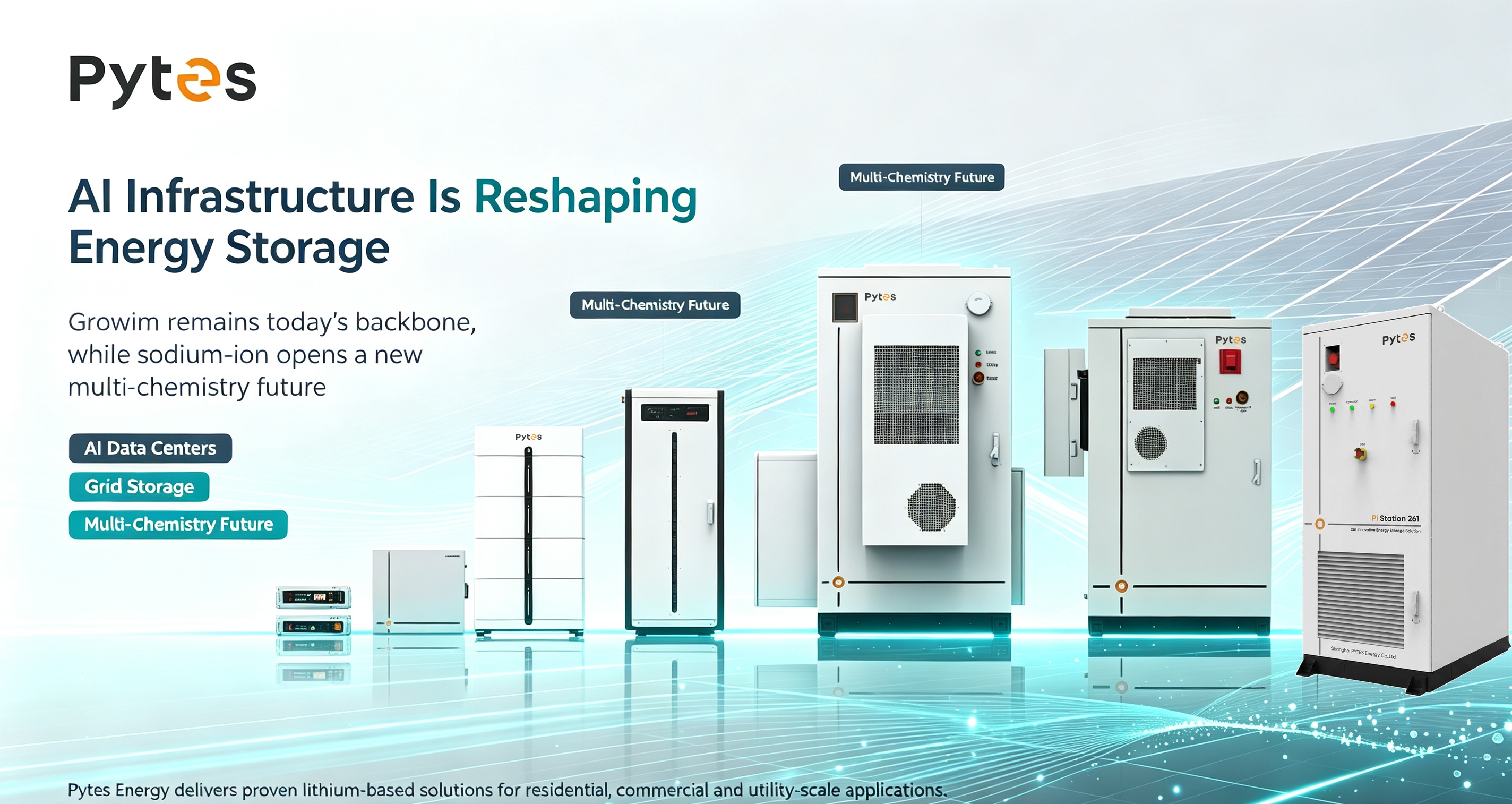
Pytes Energy has become a trusted brand in the energy storage industry by focusing on practical, reliable, and user-friendly battery solutions designed for real-world applications. Rather than pursuing a one-size-fits-all approach, Pytes offers a comprehensive portfolio that supports diverse residential and commercial energy storage requirements.
Its product range includes low-voltage server rack batteries, stackable modular battery systems, and high-voltage (HV) energy storage solutions. Every product is engineered for seamless installation, flexible system expansion, and an excellent user experience.
For homeowners, Pytes solutions help maximize solar self-consumption, provide reliable backup power, and increase energy independence. For commercial users, modular designs simplify system scaling while supporting long-term operational reliability.
As the global storage market gradually expands toward multiple battery chemistries, proven lithium-based solutions like those offered by Pytes continue to provide the performance, safety, and maturity that today's customers require.
The rapid growth of AI infrastructure is changing the energy storage landscape faster than many expected. Reuters' latest analysis suggests that sodium-ion batteries are moving steadily toward commercial reality, supported by significant investments from automakers, battery manufacturers, and energy storage developers.
However, this evolution should not be interpreted as the end of lithium-ion technology. Instead, the future of energy storage is likely to be characterized by coexistence. Different battery chemistries will address different application requirements, creating a more resilient and diversified industry.
For customers investing in energy storage today, selecting a trusted solution provider remains just as important as choosing the battery chemistry itself. With its comprehensive portfolio of residential and commercial storage products, Pytes Energy continues to help homeowners and businesses achieve energy independence while preparing for the next generation of clean energy technologies.