The U.S. battery storage market has reached a new scale, and the latest data from the U.S. Energy Information Administration (EIA) shows that this growth is accelerating rather than slowing. By the end of 2025, utility-scale battery storage capacity in the United States had reached 43.6 GW. During the first six months of 2026, operators added another 8.3 GW, bringing total nameplate capacity to nearly 52 GW. EIA reports that utility-scale battery storage capacity has averaged approximately 70% annual growth over the past three years.
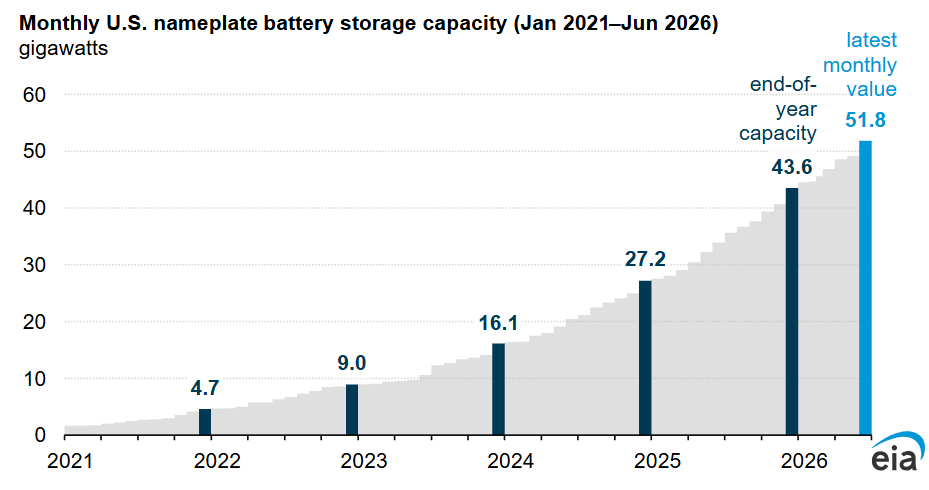
Data source: U.S. Energy Information Administration, Preliminary Monthly Electric Generator Inventory
Even more significant is what comes next. U.S. operators currently plan to add another 54 GW of battery storage capacity over the next two and a half years, including 14 GW in the second half of 2026, 26 GW in 2027, and 14 GW in 2028.
For the energy storage industry, these numbers represent more than another capacity milestone. They show that battery storage is becoming an increasingly important component of the U.S. electricity system, particularly as solar generation continues to expand.
The pace of deployment is perhaps the clearest signal from the EIA report.
At the end of 2025, the United States had 43.6 GW of operational utility-scale battery storage capacity. Adding 8.3 GW in only six months represents a substantial increase in installed capacity in a relatively short period.
This rapid growth is being supported by several practical requirements within the power market. Renewable generation is increasing, electricity demand is becoming more variable, and grid operators need additional flexibility to balance generation and consumption.
Battery energy storage systems can respond to these conditions much faster than conventional generation assets. They can charge when electricity is available and discharge when power is more valuable or more urgently required.
That flexibility is turning BESS from a supporting technology into an increasingly important grid asset.
One of the strongest signals in the EIA data is the close relationship between solar PV and battery storage.
Solar photovoltaic plants currently host the largest battery storage capacity units in the United States. The Bellefield Solar and Energy Storage Farm in California began operating in December 2025 with 500 MW of solar PV and 500 MW of battery storage. The project plans to double both its solar and storage capacity, with the additional capacity expected to become operational in November 2026. If completed as planned, it would become the largest power storage facility in the United States.
Other major projects show the same pattern. The Manatee Solar Energy Center in Florida combines 75 MW of solar generation with 409 MW of battery storage, while Nevada's Gemini Solar Hybrid includes 690 MW of photovoltaic capacity and 380 MW of storage.
The reason is fundamentally economic.
Solar generation is concentrated during daylight hours, but electricity demand and wholesale prices do not necessarily follow the same curve. Battery storage allows operators to capture electricity when prices are relatively low and discharge it when prices are higher, potentially increasing the economic value of renewable generation.
This makes solar-plus-storage increasingly attractive as a complete energy asset rather than simply two separate technologies.
As the U.S. market expands, the discussion around battery storage is moving beyond installed megawatts.
A project developer must consider the relationship between power capacity and energy capacity, because a 100 MW battery system can have very different operating characteristics depending on whether it provides 100 MWh, 200 MWh, 400 MWh, or more of energy storage.
This distinction becomes especially important as the market develops more applications requiring longer discharge durations.
A system optimized for short-duration grid response may prioritize high power output and rapid cycling. A solar-shifting project may require several hours of storage to move daytime generation into the evening peak.
The right battery architecture therefore depends on how the stored energy will actually be used.
Although the EIA data highlights utility-scale battery storage, the broader market is also moving toward increasingly flexible residential and commercial energy storage.
A home battery may be used to store excess rooftop solar power, provide backup electricity, and reduce reliance on grid power during expensive periods.
A commercial system can support peak-load management, backup power, solar self-consumption, and energy cost optimization.
These applications do not necessarily require the same architecture as a multi-hundred-megawatt grid-scale project. Instead, they benefit from modular systems that can be installed according to available space and expanded as energy requirements change.
This is one area where Pytes Energy is focusing its product strategy.
As a trusted energy storage brand, Pytes develops solutions specifically for the different requirements of modern energy storage applications. Its portfolio includes low-voltage server rack batteries, stackable modular systems, and high-voltage (HV) solutions, allowing different system configurations to be matched with residential, commercial, and larger energy storage requirements.
The rapid growth of the U.S. storage market also creates a practical challenge: not every project has the same installation conditions.
A residential energy storage system may need to fit into a limited garage or utility space. A commercial project may require multiple battery units in a dedicated equipment area. A larger installation may require a high-voltage architecture capable of supporting greater energy capacity.
A modular approach can simplify this process.
Instead of relying on a single fixed-capacity configuration, modular battery systems can allow capacity to be adjusted according to actual energy demand.
Pytes' stackable modular systems and low-voltage server rack batteries are designed with this flexibility in mind, while its HV solutions provide an option for applications requiring a different system architecture.
This approach supports a broader principle in energy storage: the battery system should adapt to the application, rather than forcing every application into the same battery configuration.
As storage deployment accelerates, installation efficiency becomes increasingly important.
Battery capacity alone does not determine the success of an energy storage project. Equipment must also integrate with inverters, energy management systems, protection equipment, communication networks, and the site's electrical infrastructure.
For residential and commercial applications, installation complexity can directly affect project cost and deployment time.
A system designed for straightforward installation, clear system integration, and practical maintenance can reduce the engineering effort required at the project site.
Pytes places particular emphasis on seamless installation and user experience across its energy storage portfolio. This focus becomes increasingly relevant as battery storage moves from specialized projects toward broader deployment across homes, businesses, and distributed energy systems.
The U.S. battery storage market is no longer small enough for reliability to be treated as a secondary consideration.
With nearly 52 GW already installed and another 54 GW planned, battery systems are becoming part of the infrastructure supporting renewable energy integration and grid flexibility.
At the equipment level, this increases the importance of battery management, cell balancing, thermal control, electrical protection, communication, and system monitoring.
At the project level, reliability also affects availability and long-term operating economics.
For residential users, reliability means maintaining backup power when the grid is unavailable. For commercial users, it can mean avoiding disruptions to critical operations. For renewable power projects, storage availability can influence the ability to shift energy into higher-value periods.
The expansion of the U.S. market therefore raises the standard for energy storage equipment: batteries must deliver not only capacity, but dependable performance throughout their operating life.
The EIA's forecasted pipeline is arguably as important as the capacity already installed.
Operators currently plan to add 54 GW of additional battery storage capacity through 2028. Of this planned capacity, approximately 14 GW is expected during the second half of 2026, 26 GW in 2027, and another 14 GW in 2028.
These figures demonstrate continued confidence in battery storage as an economically useful component of the U.S. power system.
However, planned capacity still depends on project financing, permitting, interconnection, equipment supply, construction schedules, and market conditions. The actual pace of deployment will depend on how effectively these factors can be managed.
For manufacturers and system suppliers, this makes scalability and supply-chain readiness increasingly important.
The U.S. storage boom is creating demand across multiple application levels rather than one single market.
Utility-scale projects require large-capacity systems designed for grid services and renewable energy shifting. Commercial installations need scalable systems that can support energy management and backup requirements. Residential users increasingly want batteries that integrate with solar and provide reliable energy independence.
Pytes Energy is developing its portfolio around this diversification.
Its low-voltage server rack batteries provide a practical architecture for applications requiring organized, modular battery deployment. Stackable modular systems offer greater installation flexibility where capacity and space requirements may change. High-voltage solutions address applications where a higher-voltage storage architecture is more appropriate.
This portfolio approach reflects an important market reality: the next generation of energy storage will not be defined by one battery format.
The latest EIA figures suggest that the U.S. battery storage industry is entering a new phase.
The first phase was largely about proving that batteries could support renewable integration and grid flexibility. The current phase is about deploying storage at scale and optimizing how those assets operate within increasingly complex electricity markets.
Solar-plus-storage will remain a major growth driver because batteries can shift renewable electricity from lower-value periods into periods when demand and electricity prices are higher.
At the same time, residential and commercial storage will continue developing around energy independence, backup power, solar self-consumption, and intelligent energy management.
This creates a market where capacity, scalability, installation efficiency, reliability, and system compatibility will increasingly influence purchasing decisions.
The U.S. energy storage market has reached a decisive milestone. Utility-scale battery storage grew at an average annual rate of 70% over the past three years, reached nearly 52 GW of nameplate capacity by June 2026, and has another 54 GW planned through 2028.
The rapid expansion of solar-plus-storage projects demonstrates why batteries are becoming increasingly valuable: they provide a practical mechanism for shifting electricity across time, improving the economic value of renewable generation and adding flexibility to the power system.
For Pytes Energy, this market evolution reinforces the importance of providing energy storage solutions that can scale across different applications. From low-voltage server rack batteries and stackable modular systems to high-voltage solutions, Pytes is building a portfolio designed to make energy storage more adaptable, easier to deploy, and better suited to the diverse requirements of modern energy systems.
As the United States moves toward an even larger installed base of battery storage, the next competitive advantage will not simply be having more battery capacity. It will be delivering reliable, scalable, intelligently designed storage that can work efficiently within real-world energy systems.