As residential solar and energy storage systems become more widely adopted, battery selection is no longer simply about choosing the largest capacity. Installers and homeowners need to consider usable energy, continuous discharge power, peak current, cycle life, environmental protection, and expansion capability together.
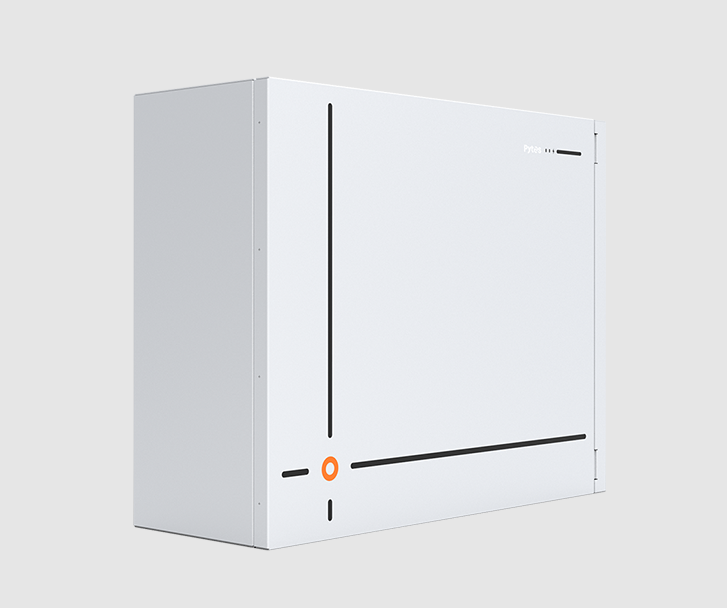
The Pytes V10α is designed around a 51.2V, 200Ah LFP battery architecture, delivering 9.98kWh of rated energy. It also provides approximately 9.98kWh of usable energy, up to 200A peak discharge for 180 seconds (equivalent to 10.24 kW), and a rated cycle life of up to 8,000 cycles under specified test conditions. These parameters make the V10α a practical option for residential solar storage and backup power applications.
The Pytes V10α combines a 51.2V nominal voltage with a 200Ah rated capacity. Multiplying these two values gives approximately 9.98kWh of rated energy.
This energy level places the V10α in a practical range for residential storage applications. A single battery can provide meaningful backup power for essential household loads, including refrigerators, lighting, networking equipment, televisions, and other critical appliances.
It is important to distinguish between rated energy and usable energy. For the V10α, the usable energy is approximately 9.98kWh per the current specifications—meaning the rated and usable energy figures are effectively the same. This usable energy value is the more relevant metric when estimating actual backup duration.
For context, a theoretical 1kW average load would consume 9.98kWh in approximately 10 hours, while a 2kW load would deplete the same energy in about 5 hours. Real-world runtime will vary depending on inverter efficiency, load fluctuations, ambient temperature, reserve settings, and other system-specific factors.
Battery capacity determines how much energy can be stored, but discharge capability determines how much power the battery can deliver at a given time.
The Pytes V10α specifies a recommended continuous charge and discharge current of 120A, corresponding to approximately 6.14kW of battery-side power (calculated as 120A × 51.2V). It also provides a peak discharge capability of 200A for 180 seconds, delivering up to 10.24kW of short-term power.
The difference between continuous and peak current is important in residential applications. Some household appliances, particularly refrigerators, pumps, compressors, and motor-driven equipment, can require a significantly higher current during startup than during normal operation. The 200A/180s peak capability provides additional short-duration current support for these types of loads.
It should not, however, be interpreted as a continuous 200A output rating. The actual power available to household loads also depends on the connected inverter and the overall system design.
Cycle life is one of the most important parameters for a battery that may charge and discharge every day.
The Pytes V10α uses lithium iron phosphate (LFP) battery technology and is rated for up to 8,000 cycles under specified testing conditions. Pytes documentation associates this rating with conditions including 25°C, 0.5C charge/discharge, 90% depth of discharge, and a 70% end-of-life capacity criterion.
In a typical solar-plus-storage application, the battery may be charged during the day and discharged at night. A high cycle-life rating can therefore be valuable for systems designed for frequent daily operation.
Actual service life will depend on operating temperature, charging and discharging rates, depth of discharge, system configuration, and energy-management strategy.
Residential batteries are not always installed in climate-controlled indoor rooms. Garages, utility areas, exterior walls, and semi-outdoor locations are also common installation environments.
The V10α's IP66 enclosure rating provides dust-tight protection and protection against powerful water jets. This makes the enclosure better suited to demanding installation environments than batteries designed only for protected indoor locations.
The V10α also features C4-M corrosion resistance and an integrated heating function. These specifications are particularly relevant when the battery must operate in environments where humidity, temperature changes, or corrosive conditions need to be considered.
The published operating range also supports a broad range of conditions, although installers should always follow the manufacturer's requirements for temperature, mounting, ventilation, and environmental protection.
Battery dimensions can have a direct impact on installation planning.
The Pytes V10α measures approximately 688.4 ± 2.0 × 260 ± 2.0 × 520.0 ± 2.0 mm and weighs around 98.4 kg. It supports wall-mounted or floor-mounted installation, depending on the system configuration and installation accessories.
The approximately 260mm depth is particularly relevant for residential applications where available floor space is limited.
Instead of using multiple smaller battery modules to reach a similar energy level, a single V10α provides approximately 9.98kWh of nominal energy in one enclosure. This can simplify mechanical installation and reduce the number of battery-to-battery connections required.
For installers, the physical configuration should still be evaluated alongside access requirements, mounting structure, cable routing, and local installation regulations.
One of the advantages of a modular battery architecture is the ability to expand capacity as energy requirements increase.
Based on the 9.98kWh rated energy per unit, two V10α batteries provide approximately 19.96kWh, while four units provide approximately 39.92kWh. The V10α platform supports up to 16 units in parallel according to Pytes product information, allowing a theoretical total rated capacity of approximately 159.68kWh (16 × 9.98kWh).
This type of scalability is useful for larger residential systems or applications where storage capacity may need to increase over time.
However, battery capacity should not be evaluated independently from the inverter. The maximum system output, charging current, communication architecture, and expansion limits depend on the complete battery-inverter configuration.
A modern energy storage battery needs to communicate effectively with the inverter and other system components.
The Pytes V10α supports communication interfaces including CAN, RS485, Wi-Fi, and dry contact. These interfaces allow the battery management system to exchange operating information with compatible equipment.
CAN and RS485 can be used for equipment communication, while Wi-Fi can support monitoring functions in compatible configurations.
This communication capability is important because the battery should not simply charge and discharge based on voltage alone. The inverter and BMS need to coordinate parameters such as state of charge, current, voltage, and protection limits to operate the system correctly.
Compatibility should always be confirmed between the specific V10α revision and the selected inverter before installation.
For residential solar and backup applications, the Pytes V10α offers a combination of capacity and power that can cover a wide range of household requirements.
Its approximately 9.98kWh usable energy makes it suitable for storing excess solar generation during the day and supplying household loads later. Continuous battery-side power capability can support many residential loads when properly matched with an inverter, while the 200A peak current rating provides additional support for short-duration startup demands.
Its LFP chemistry and 8,000-cycle rating are also important for homeowners expecting regular daily cycling rather than occasional emergency backup.
For larger systems, multiple V10α batteries can be combined to increase total energy storage capacity.
The Pytes V10α is more than an 9.98kWh residential battery. Its performance comes from the combination of several measurable specifications: 51.2V nominal voltage, 200Ah capacity, 200A peak discharge for 180 seconds, and an 8,000-cycle rated life under specified test conditions.
IP66 protection, C4-M corrosion resistance, integrated heating, multiple communication interfaces, and scalable parallel installation further expand its application potential.
For homeowners and installers evaluating a residential energy storage system, these parameters provide a more practical basis for decision-making than general claims such as “high performance” or “long life.” The final selection should always be based on the exact V10α product revision, inverter compatibility, household load profile, installation environment, and applicable local requirements.