As residential and commercial energy storage systems evolve, performance expectations are no longer defined by capacity alone. Modern ESS users require higher discharge capability, wider operating temperature tolerance, stronger system scalability, and real-time remote management.
The Pytes V5° / V5°α battery system is designed precisely for this transition. Built on a 51.2V LFP architecture with a high continuous discharge capability of 100A, peak output up to 180A (15 seconds), and scalable system expansion up to 491.52kWh per hub-based configuration, the V5° platform represents a new generation of modular energy storage designed for both residential resilience and commercial flexibility.
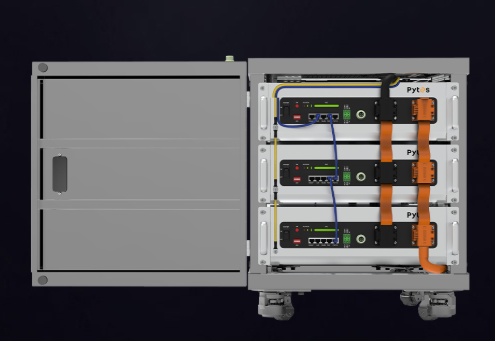
Unlike traditional low-rate storage batteries that are limited by conservative thermal and electrical design, the V5° system is engineered for higher power responsiveness, tighter system integration, and long-cycle operational stability exceeding 6000 cycles with a 10-year warranty.
At the core of the V5° system is a Lithium Iron Phosphate (LFP) chemistry platform, operating at a nominal voltage range of 47.5V to 57.6V. This voltage window is optimized for stable inverter compatibility and efficient energy conversion under dynamic load conditions.
Where many conventional 48V-class systems are restricted to conservative discharge rates, the V5° significantly expands usable power output:
· Recommended charge/discharge current: 75A
· Maximum continuous charge/discharge current: 100A
· Peak discharge capability:
o 101A–120A for 3 minutes
o 121A–180A for 15 seconds
This peak performance capability is particularly important for real-world scenarios such as HVAC startup loads, industrial peak shaving events, or grid outage backup surges, where short-duration high current demand is critical.
Instead of designing for theoretical capacity alone, the V5° platform is optimized for practical load volatility, ensuring stable output under sudden demand spikes.
Energy storage systems deployed in residential garages, utility rooms, or semi-outdoor environments must operate under highly variable thermal conditions.
The V5° system is engineered for a wide ambient temperature range of:
· -10°C to 50°C (14°F to 122°F)
In addition, integrated heating pad functionality extends low-temperature usability:
· Heating rate: 8°C/hour (14.4°F/hour)
· Extended operation support: down to -18°C (0°F)
· Optional enhanced heating: 10°C/hour (18°F/hour)
This thermal architecture ensures that the battery system maintains usable performance even in cold-start conditions where conventional LFP systems may suffer from reduced charge acceptance or temporary shutdown.
Rather than relying solely on passive insulation, the V5° integrates active thermal stabilization, improving both reliability and seasonal adaptability.
Despite its high power capability, the V5° maintains a compact mechanical footprint:
· Dimensions: 442 × 530 × 140 mm (3.2U form factor)
· Weight: 44 kg (97 lbs)
This form factor allows flexible installation in wall-mounted or floor-mounted configurations, supported by optional battery tray mounting systems.
Higher energy density is achieved not only through cell-level optimization but also through structural integration efficiency, reducing unused internal volume while maintaining thermal separation and safety margins.
In practical deployment terms, this enables installers to maximize energy capacity per square meter of installation space—an increasingly critical factor in residential garages and commercial energy rooms.
One of the most significant engineering advantages of the V5° platform is its modular scalability.
System expansion is structured as follows:
· 16 units per group = 81.92kWh
· Up to 6 groups per system via hub integration
· Maximum system capacity = 491.52kWh
This hierarchical architecture allows energy storage systems to scale from residential single-home applications to large commercial or light industrial deployments without changing the core battery architecture.
Instead of requiring different product lines for different capacities, the V5° system enables linear scalability through standardized modules, reducing integration complexity and inventory fragmentation.
Modern energy storage systems are no longer static hardware installations. They are continuously managed energy assets.
The V5° integrates dual communication protocols:
· CAN bus
· RS485
In addition, built-in WiFi connectivity enables:
· Remote monitoring
· Firmware upgrades
· System diagnostics
· Performance optimization updates
This allows lifecycle management without physical intervention, reducing maintenance cost and improving system uptime.
Remote upgrade capability is particularly important in distributed deployments, where manual servicing is costly or impractical. Instead of replacing hardware, system performance can be continuously improved through software-level optimization.
Two connection configurations are available depending on deployment requirements:
· V5°: PHOENIX M6 bolt connection
· V5°α: Amphenol SurLok Plus 8.0mm connector system
The use of industrial-grade connector systems ensures:
· High current stability under continuous load
· Reduced contact resistance
· Improved installation efficiency
· Enhanced mechanical durability under vibration conditions
This dual-connection strategy allows the system to adapt to both cost-sensitive residential installations and high-reliability commercial deployments.
The V5° platform is designed for long operational lifecycles:
· ≥6000 cycles
· 10-year warranty coverage
In practical terms, this cycle performance supports daily deep cycling in residential self-consumption systems or frequent dispatch cycles in commercial peak shaving applications.
Long cycle life is not only a performance metric—it directly impacts total cost of ownership. A system with higher cycle stability reduces replacement frequency, improves ROI predictability, and stabilizes long-term energy cost planning.
To support international deployment, the V5° system complies with a comprehensive certification framework:
· UL9540 Ed.2 (2020)
· UL9540A
· UL1973
· CEC
· SGIP
· CE
· IEC62619
· UN38.3
This certification set ensures compliance across North American, European, and international transport and installation standards, enabling faster project approval and regulatory acceptance.
The real engineering value of the V5° system is not defined by individual specifications alone, but by how those specifications interact at system scale.
High discharge current capability ensures real-world load responsiveness.
Wide temperature tolerance ensures deployment flexibility.
Modular scalability ensures long-term system expansion.
Remote monitoring ensures lifecycle efficiency.
Together, these characteristics form a storage platform designed not just for energy retention, but for continuous operational adaptability in dynamic energy environments.
The Pytes V5° / V5°α battery system represents a shift in 48V-class energy storage design philosophy.
With a 100A continuous discharge capability, 180A peak output, scalable architecture up to 491.52kWh, integrated heating support, and full remote management functionality, the system is engineered for environments where both performance and reliability must coexist under real operational stress conditions.
Rather than optimizing for isolated metrics, the V5° platform is built as a system-level energy asset, capable of adapting to residential, commercial, and hybrid energy applications with consistent long-term performance.