As commercial and industrial facilities increase their reliance on solar power, EV charging, and energy storage, battery systems need to deliver more than basic capacity. High-voltage architecture can reduce operating current, limit resistive losses, and provide a practical path toward larger storage systems. The Pytes HV48100 is designed around this principle, combining 51.2V, 100Ah LFP battery modules with a high-voltage control architecture to support scalable energy storage for commercial, industrial, agricultural, EV charging, and off-grid applications.
One of the key advantages of the HV48100 is its high-voltage system architecture. The system can operate across a nominal system voltage range of 256–768V, while individual battery modules use a nominal voltage of 51.2V. By increasing system voltage, the same power output can be achieved with lower current, which helps reduce resistive heating and associated energy losses. Pytes specifically positions this architecture as a way to improve round-trip efficiency and reduce daily operating costs.
For commercial and industrial energy storage, this matters because systems may cycle regularly for peak shaving, solar self-consumption, backup power, or time-of-use energy management. Even relatively small efficiency improvements can become meaningful when a system operates repeatedly over many years.
Each HV48100 battery module uses lithium iron phosphate (LFP) chemistry and provides a nominal voltage of 51.2V, nominal capacity of 100Ah, and nominal energy of 5.12kWh. The module supports a continuous charge/discharge current of 50A, with communication through CAN and RS485.
The modular design allows system capacity to be matched to actual energy requirements instead of requiring a fixed-size battery configuration. The standard HV48100 system can use 5 to 15 battery modules, providing nominal system energy from 25.6kWh to 76.8kWh according to the current technical documentation.
This approach is useful for facilities with different load profiles. A smaller installation can start with a lower storage capacity, while larger applications can add modules to increase available energy without changing the fundamental battery architecture.
The system-level specifications show how the 5.12kWh modules translate into different storage configurations. With 5 modules, the nominal energy is 25.6kWh; 10 modules provide 51.2kWh; and 15 modules provide 76.8kWh. The corresponding nominal system voltage ranges from 256V to 768V, while the nominal capacity remains 100Ah.
The current Pytes HV48100 documentation also lists configurations such as 5S2P, 6S2P, 7S2P, 12S1P, 13S1P, 14S1P, and 15S1P. Depending on configuration, rated energy ranges from 51.20kWh to 76.80kWh, with rated power reaching up to 38.40kW in the listed 15S1P configuration.
For system designers, these configurations provide flexibility when balancing voltage requirements, available power, inverter compatibility, and installation space.
Battery longevity is particularly important for commercial energy storage because the economic value of a BESS depends heavily on how consistently it can deliver energy over its operating life.
The HV48100 is based on LFP chemistry and is specified for a cycle life of 6,000 cycles or more. Pytes also states that the system can achieve cycle efficiency of up to 95%.
The combination of long cycle life and high efficiency makes the HV48100 suitable for applications involving repeated daily cycling. For example, a commercial facility can charge the battery when solar generation is available or electricity prices are lower, then discharge it during peak-demand periods.
Rather than evaluating a battery only by its initial energy capacity, project developers should consider how efficiently that capacity can be used over thousands of operating cycles.
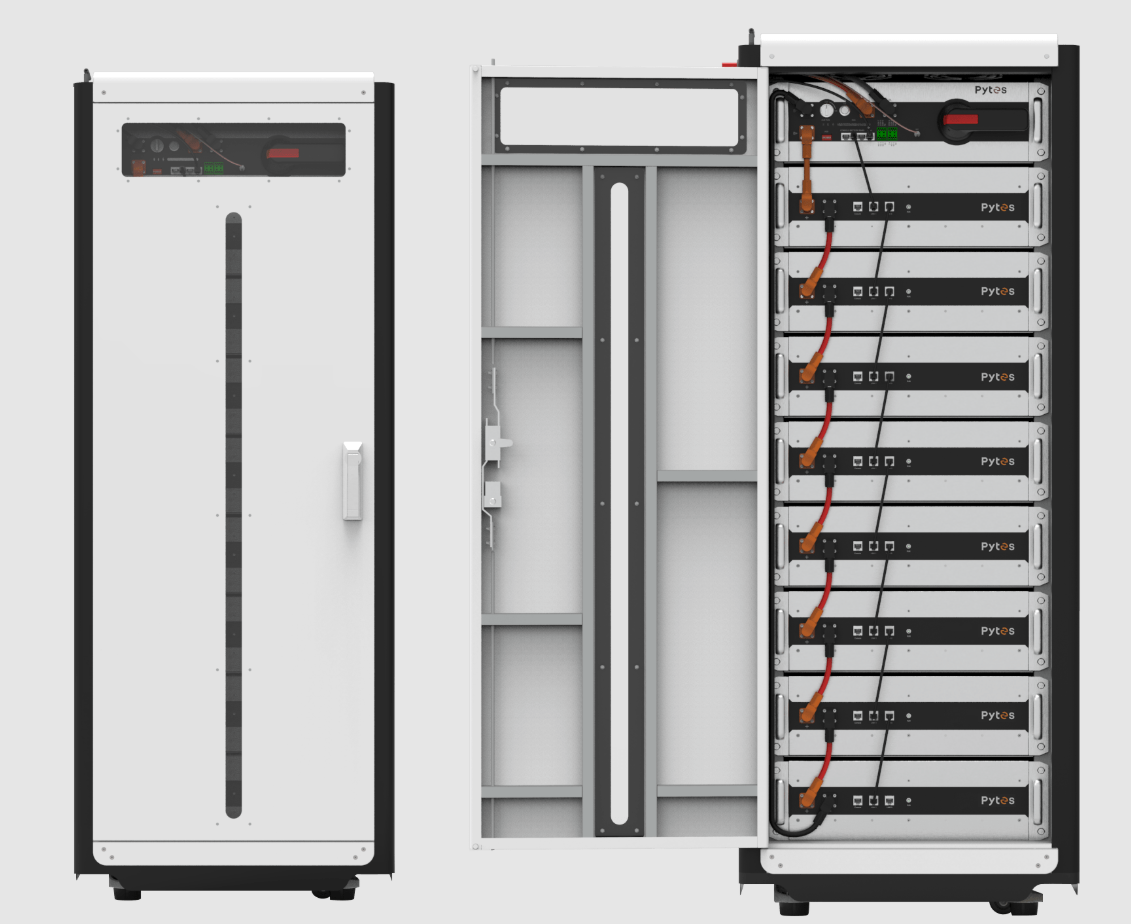
The HV48100 is designed as an integrated energy storage system rather than a collection of independent battery modules. The indoor IP20 cabinet integrates battery packs, high-voltage control, and an intelligent battery management system into a single enclosure.
The battery management system is particularly important for a high-voltage configuration because it monitors and manages the operating condition of the battery modules. Pytes describes its BMS as self-designed and field-proven, while the system uses CAN and RS485 communications for system-level communication.
This integrated approach can simplify system architecture and reduce the complexity associated with combining separate battery and high-voltage control components.
The HV48100 is not limited to one energy storage scenario. Pytes specifically identifies commercial buildings, light industrial facilities, agriculture, EV charging, and off-grid applications as target use cases. The system can support functions including peak shaving, demand charge reduction, solar self-consumption, energy cost reduction, and commercial backup power.
For a commercial building, for example, excess solar generation can be stored rather than exported immediately, allowing more of the generated electricity to be used later. During high-demand periods, stored energy can help reduce the amount of electricity drawn from the grid.
For EV charging facilities, battery storage can also help manage the additional electrical load created by charging infrastructure. Instead of requiring every power increase to come directly from the grid, the battery can provide additional flexibility during high-load periods.
The HV48100 system is designed for indoor installation and operates in a wide temperature range. The technical specifications specify charging operation from 0°C to 45°C and discharging operation from -10°C to 50°C, with relative humidity from 5% to 80% non-condensing and an operating altitude below 4,000m.
The system also carries a 10-year warranty, while its listed certifications include UL 9540 Ed.3 (2023), UL 9540A, UL 1973, CEC, and SGIP. These certifications are particularly relevant for customers evaluating energy storage solutions for the North American market.
The technical characteristics of the Pytes HV48100 point to a clear design philosophy: use high-voltage architecture to reduce current-related losses, combine LFP chemistry with long cycle life, and use modular battery configurations to match different project requirements.
Its key specifications provide a practical reference:
51.2V / 100Ah / 5.12kWh per battery module
256–768V nominal system voltage
25.6–76.8kWh nominal system energy
50A continuous charge/discharge current
6,000+ cycle life
Up to 95% cycle efficiency
5–15 BMUs per system
CAN + RS485 communication
IP20 indoor cabinet
10-year warranty
UL 9540 Ed.3, UL 9540A, UL 1973, CEC and SGIP
These specifications make the HV48100 a technically focused option for customers that need a scalable battery platform rather than a fixed-capacity storage product.
The value of a commercial battery system is increasingly determined by how effectively it integrates with the rest of the energy infrastructure. A battery that can store solar energy but cannot respond effectively to demand patterns may leave significant economic value unused.
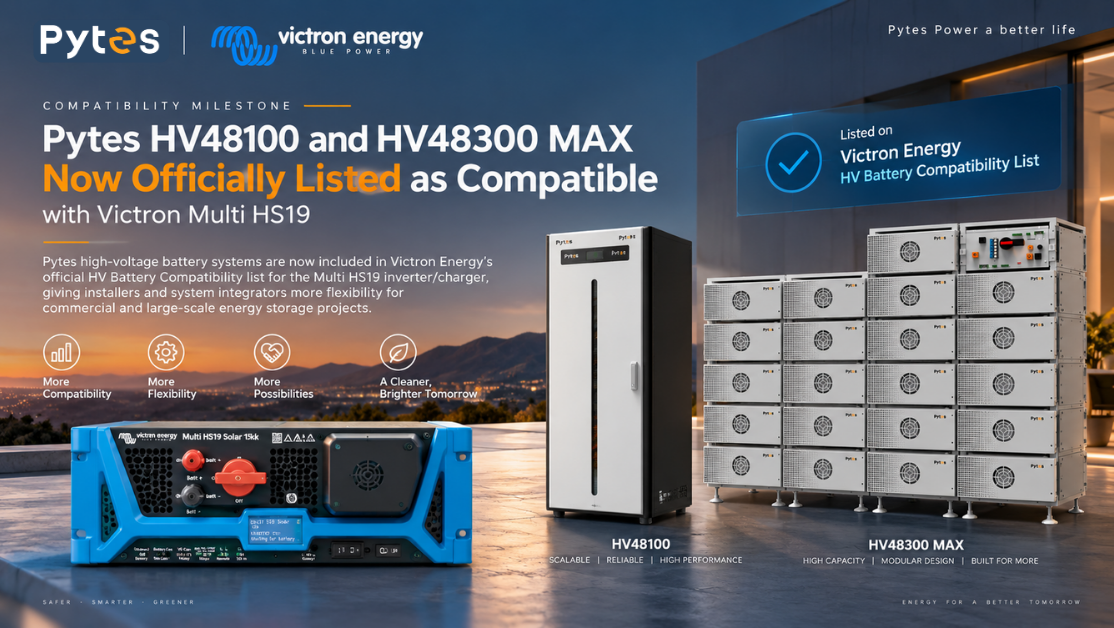
The Pytes HV48100 addresses this challenge through high-voltage architecture, modular capacity, LFP chemistry, intelligent BMS, and compatibility with major inverter brands. Pytes states that the system is designed to support expansion from smaller installations toward larger commercial and industrial configurations, including MWh-level capacity through modular system architecture.
For businesses evaluating energy storage, the most important consideration is therefore not simply how many kilowatt-hours a battery provides. The more relevant question is whether the system can deliver the required power efficiently, operate reliably through repeated cycles, integrate with the selected inverter, and scale as energy requirements increase.
With its 5.12kWh LFP modules, up to 76.8kWh in the documented system configuration, 256–768V system voltage range, 6,000+ cycle life, and up to 95% cycle efficiency, the Pytes HV48100 provides a high-voltage platform designed around those requirements.