The rapid expansion of artificial intelligence is creating a new challenge for the global power sector: how to deliver reliable, flexible, and scalable electricity to increasingly energy-intensive data centers. A recent S&P Global analysis highlights this shift, forecasting global annual energy storage additions of approximately 165 GW in 2026, nearly 40% higher than in 2025, with annual additions expected to exceed 210 GW by 2030. In the United States, the 2026 forecast has been raised to approximately 25 GW, compared with around 18 GW added in 2025. The growth reflects not only renewable energy expansion but also the rising electricity requirements of hyperscale data centers and AI infrastructure.
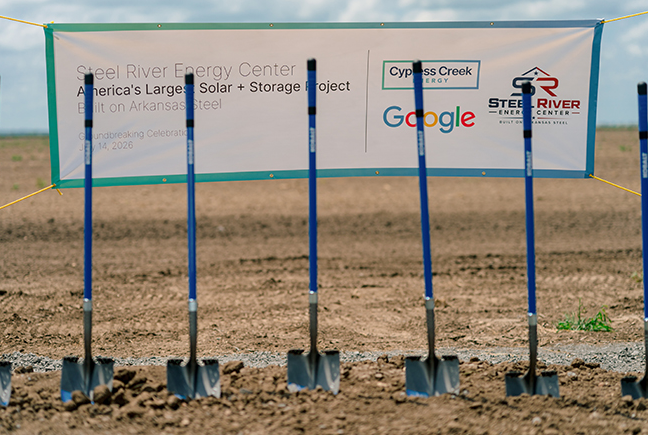
Source: Cypress Creek Energy.
Energy storage has traditionally been closely associated with solar and wind projects, where batteries store excess renewable electricity and release it when demand increases. AI data centers are now creating a different set of requirements. Their enormous and sometimes rapidly changing power loads make electricity reliability and power quality critical operational concerns. Battery energy storage systems can respond extremely quickly, allowing them to support backup power, reduce peak demand, smooth load fluctuations, optimize on-site generation, and improve overall power flexibility. S&P Global describes batteries as increasingly versatile resources for data centers, demonstrating that BESS is evolving from a renewable energy accessory into an important part of modern power infrastructure.
The connection between hyperscale technology companies and energy suppliers is becoming increasingly direct. Google, for example, has agreed to purchase power from the Steel River Energy Center in Arkansas, where the first two phases combine 1.6 GW of solar capacity with 1.9 GWh of battery storage. The development is planned to expand to 2.5 GW of solar and 2.9 GWh of storage by 2029 and is located near Google's planned hyperscale data center in West Memphis. In Texas, Google's collaboration with Intersect Power is similarly connecting data center development with renewable generation and battery storage. These projects demonstrate how hyperscalers are increasingly considering electricity generation, storage, and grid access as an integrated part of their data center strategy.
Utility-scale BESS remains an important growth area, but behind-the-meter storage is also becoming increasingly attractive. S&P Global estimates that U.S. businesses and homeowners could add almost 7 GW of on-site battery storage in 2026 and nearly 10 GW in 2027, with industrial applications expected to account for a significant share of this growth. For commercial facilities, on-site storage can store excess solar power, reduce demand charges, provide backup electricity, and shift consumption away from expensive periods. For AI data centers, these capabilities become even more valuable because batteries can work alongside grid power, renewable generation, and other generation resources to provide greater flexibility and resilience.
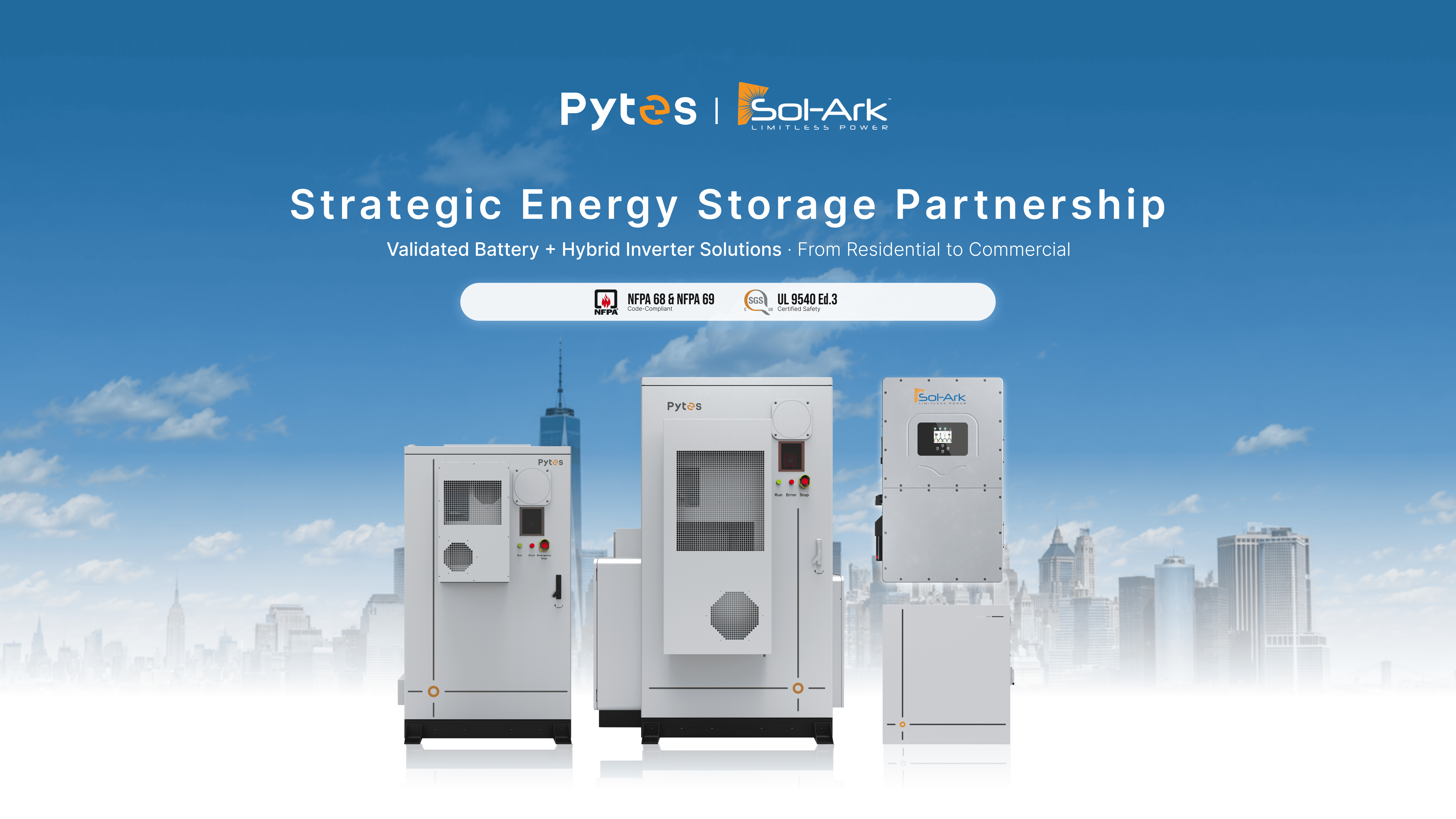
As energy storage applications become increasingly diverse, customers need systems that can adapt to different project sizes, installation conditions, and future energy demands. By developing solutions around the real-world needs of homeowners and businesses, Pytes Energy has established itself as a trusted brand in the energy storage industry.
Its product portfolio covers a comprehensive range of low-voltage and high-voltage energy storage solutions, giving customers multiple options for building scalable and flexible battery energy storage systems (BESS).
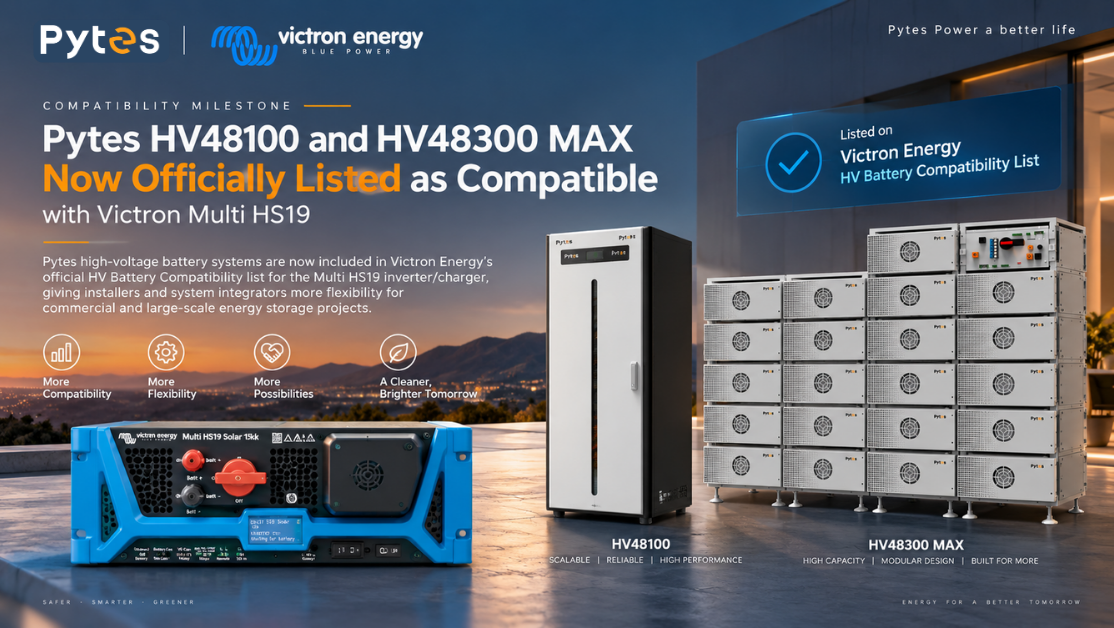
In the high-voltage energy storage sector, Pytes has introduced the HV48100, HV48100 SE, and HV48300 Max SE series, forming a comprehensive high-voltage energy storage solution portfolio.
The HV48100 is designed for applications such as commercial buildings, light industrial facilities, and agriculture. Building on the standard version, the HV48100 SE has been optimized and upgraded to further enhance system integration and configuration flexibility, making it better suited to the diverse needs of medium-sized commercial and industrial projects.
The HV48300 Max SE is designed for larger-scale commercial and industrial energy storage applications. It supports higher power output and greater capacity expansion, making it suitable for more complex applications such as demand charge reduction, time-of-use tariff optimization, energy independence, and Virtual Power Plant (VPP) participation.
All three products share the same technology platform, featuring LFP battery chemistry, an intelligent BMS, and a high-voltage architecture. Customers can flexibly select the right solution based on project scale, power requirements, and budget, enabling smooth scalability from small and medium-sized commercial projects to large-scale industrial applications.
Battery chemistry is another factor shaping the energy storage market. For stationary applications, energy density is only one consideration; safety, cycle life, cost, thermal performance, and long-term reliability are equally important. This is one reason lithium iron phosphate, or LFP, has become an important technology for energy storage systems. Pytes incorporates LFP technology across its product portfolio, combining it with modular system designs to provide practical solutions for different storage scenarios.
The emphasis on modularity is particularly relevant as electricity demand becomes more difficult to predict. A commercial facility may initially require a relatively small battery system but later need additional capacity because of increased production, solar expansion, EV charging, or new equipment. A modular storage architecture allows the system to evolve without requiring the entire energy infrastructure to be redesigned.
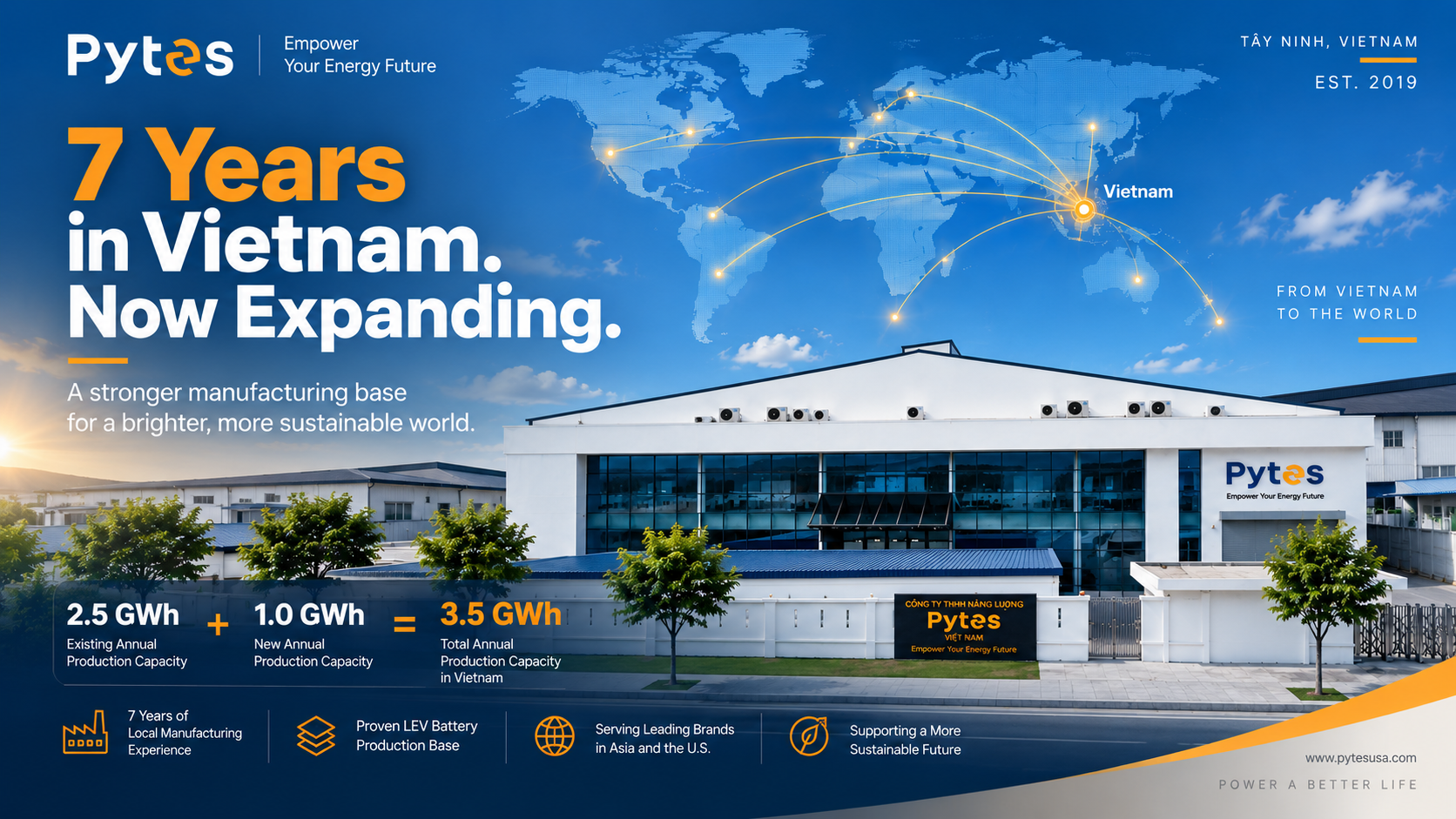
The growth of AI and data centers is also influencing the global battery supply chain. According to S&P Global, battery manufacturers are increasingly retooling production lines originally designed for electric vehicle applications toward energy storage, with some conversions capable of being completed in less than a year. This demonstrates how quickly manufacturers are responding to the changing balance between EV and stationary storage demand.
For project developers, however, battery availability is only one part of the equation. Installation efficiency, system compatibility, commissioning requirements, scalability, and long-term service can all affect project economics and deployment schedules. Pytes addresses these requirements through a portfolio that ranges from rack-mounted low-voltage batteries and stackable modular systems to high-voltage solutions for larger commercial and industrial applications. This product diversity allows installers and system integrators to select an architecture that better matches the scale and technical requirements of individual projects.
The latest developments suggest that batteries are moving beyond their traditional role of storing renewable electricity. A modern energy storage system can simultaneously support backup power, peak demand management, renewable energy shifting, AI load smoothing, on-site generation optimization, energy arbitrage, grid flexibility, and energy independence. This multifunctionality is one of the strongest reasons why energy storage is attracting attention from technology companies, utilities, renewable developers, commercial customers, and homeowners.
At the same time, rapid development creates new challenges. S&P Global points out that community opposition to data center construction could affect some renewable and storage projects associated with new AI infrastructure, potentially causing delays or cancellations. This highlights the fact that future energy storage deployment will depend not only on battery technology but also on permitting, grid access, supply chains, project economics, and community acceptance.
The latest S&P Global outlook shows that the energy storage industry is entering a stronger growth cycle, with global annual additions expected to reach approximately 165 GW in 2026 and surpass 210 GW by 2030. The United States is also expected to install around 25 GW in 2026, reflecting the growing importance of both utility-scale and distributed storage.
AI is becoming an important catalyst behind this expansion. As hyperscalers continue building energy-intensive data centers, reliable and flexible power resources will become increasingly important, while renewable energy growth, grid constraints, electricity price volatility, and demand for energy independence will continue supporting storage adoption.
For Pytes Energy, this changing market reinforces the importance of flexible and scalable product architectures. From low-voltage server rack batteries and stackable modular systems to high-voltage solutions, Pytes is developing energy storage options designed to support different residential, commercial, and industrial requirements.
The next generation of energy storage will not simply be defined by larger battery capacity. It will be defined by how effectively storage systems integrate with renewable generation, electrical infrastructure, intelligent energy management, and rapidly growing loads such as AI data centers. As the digital economy continues to consume more electricity, flexible energy storage is becoming a critical link between power generation and the future of computing.