Latin America is entering a decisive phase in energy storage. According to Wood Mackenzie’s latest Latin America energy storage outlook, cumulative energy storage capacity is projected to increase from 2.5 GW in 2025 to 34 GW by 2035, representing approximately 13-fold growth and a 30% CAGR. The forecast is being driven by accelerating storage tenders, rising renewable-energy curtailment, and transmission infrastructure that has not kept pace with new generation capacity.
This shift is important because Latin America's storage opportunity is moving beyond pilot projects. Energy storage is increasingly becoming a practical tool for managing renewable-energy variability, reducing curtailment, improving grid flexibility, and supporting reliable electricity supply. As the market expands, battery systems will need to combine scalable capacity, reliable battery management, installation flexibility, and long-term operating performance.
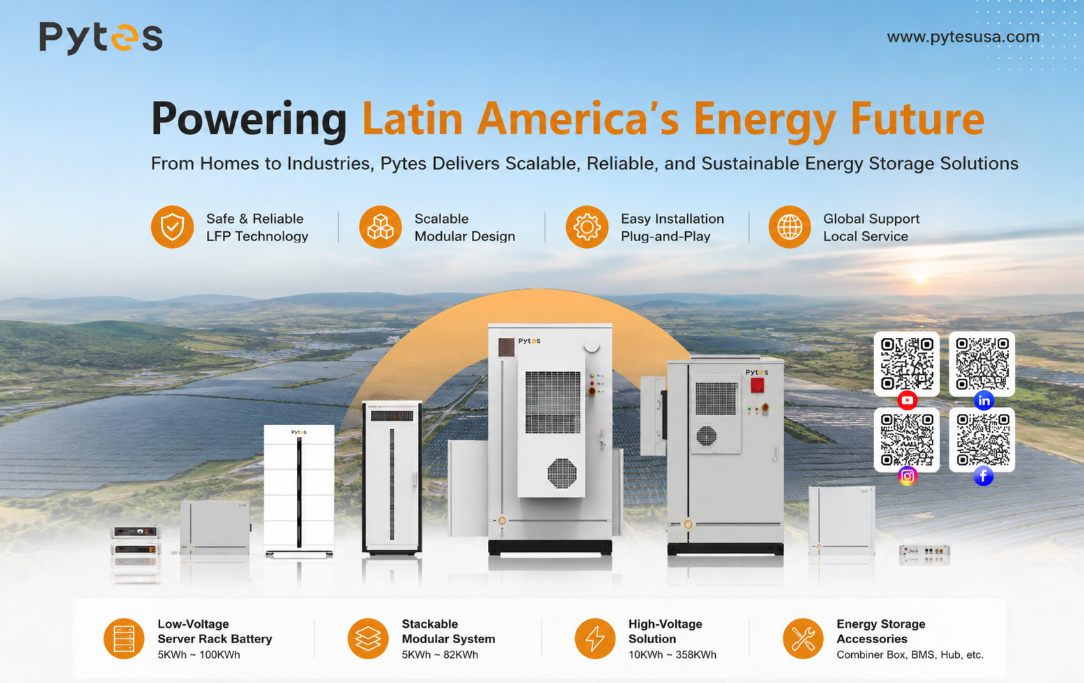
For Pytes Energy, this market transition aligns closely with its approach to energy storage. Pytes has developed a portfolio covering low-voltage server rack batteries, stackable modular systems, and high-voltage solutions, allowing different storage configurations to be matched with residential, commercial, industrial, and other energy applications.
Wood Mackenzie's forecast is significant not only because of the projected capacity, but because of what is driving the growth.
Latin America's renewable-energy resources are expanding rapidly, particularly solar power in regions with strong solar irradiation. However, generation capacity alone does not guarantee that electricity can be delivered when and where it is needed. Transmission constraints can force renewable generators to reduce output, while fluctuations between renewable generation and electricity demand create a growing need for flexible resources.
Energy storage addresses this mismatch by shifting electricity across time. A battery can charge when renewable generation is abundant and discharge when generation falls or demand rises.
This makes the value of BESS increasingly connected to grid conditions rather than simply the cost of battery cells.
For storage suppliers, the implication is clear: systems need to be designed for actual operating scenarios, including the required energy duration, discharge power, ambient conditions, installation environment, cycling frequency, and expansion requirements.
Chile remains the regional leader in energy storage and has some of Latin America's largest operational BESS projects. Wood Mackenzie highlights renewable-energy curtailment as an important driver of investment in longer-duration storage systems. At the same time, increasing storage penetration in northern Chile is creating a potential risk of price cannibalisation, which could reduce arbitrage revenues as more storage capacity enters the market.
This creates an increasingly sophisticated project-development environment.
A storage system cannot be evaluated solely on nominal MWh capacity. Developers also need to consider how frequently the battery will cycle, how many hours it must discharge, the expected degradation profile, inverter compatibility, thermal management, and the revenue mechanisms available in a specific electricity market.
Pytes' product architecture provides flexibility at different system levels. Its low-voltage batteries can support distributed energy storage applications, while stackable systems allow capacity to grow as energy requirements increase. For larger applications, Pytes also provides high-voltage solutions such as the HV48100, which uses LFP battery technology, supports more than 6,000 cycles, and achieves cycle efficiency of up to 95%.
These characteristics are particularly relevant when storage is expected to operate repeatedly rather than function only as occasional backup power.
Mexico represents another market to watch closely.
Wood Mackenzie describes Mexico as being at a policy-driven inflection point. New enabling mechanisms, including a priority call for proposals and a joint development call involving Mexico's Federal Electricity Commission, include mandatory storage requirements and are expected to award more than 3 GW of storage capacity by 2030.
Mandatory storage requirements can fundamentally change project design.
Instead of treating batteries as an optional addition to a solar or power-generation project, developers increasingly need to consider storage from the initial system architecture. This means battery voltage, usable energy, power output, inverter communication, installation footprint, thermal management, and future expansion all become part of the engineering decision.
For distributed applications, modularity can be particularly valuable. Pytes' V5° platform, for example, can be configured with up to 16 units or 82 kWh in one stack, while a system using the Pytes Hub can support up to 6 stacks and 492 kWh.
This type of scalable architecture allows system capacity to be matched more closely with actual load requirements instead of forcing users to select a single fixed-capacity battery configuration.
Latin America covers a wide range of climates and installation conditions, from high-temperature regions to remote off-grid locations. Battery performance therefore cannot be separated from environmental conditions.
Thermal management is particularly important because elevated operating temperatures can accelerate battery degradation and influence system performance.
Pytes has incorporated features aimed at improving deployment flexibility. Its V-series portfolio includes LFP battery technology, field-proven battery management systems, and, on selected products, integrated self-heating functions for low-temperature operation.
Installation architecture also matters. A battery that requires complicated field wiring can increase installation time and introduce additional opportunities for connection errors. Pytes emphasizes plug-and-play connectors and flexible rack or cabinet configurations across its low-voltage product portfolio, supporting more straightforward system deployment.
For installers working across different Latin American markets, these practical considerations can be as important as the headline battery capacity.
The Latin American opportunity is not limited to utility-scale BESS.
Businesses, remote facilities, commercial buildings, agricultural operations, and homes can also use batteries to reduce dependence on unstable grid supply, increase solar self-consumption, and maintain critical loads during outages.
A real-world example can be seen in Puerto Rico, where a Pytes E-Box-48100R system paired with Sol-Ark LATAM & Caribbean inverters was deployed at the Diamante Adventure Eco Park. According to Pytes, the installation reduced monthly energy bills from $600 to $200, a reduction of approximately 67%, while providing a more reliable power supply.
The case demonstrates why storage economics should be measured against the actual electricity profile of a facility. Battery capacity, solar generation, tariff structure, backup requirements, and load management all affect the financial return.
A major characteristic of the Latin American storage market will be diversity.
A remote residential system may require a relatively small battery bank, while a commercial facility may need hundreds of kilowatt-hours. A utility-scale project can require megawatt-hour-scale storage with completely different voltage and integration requirements.
Using one fixed architecture across all applications is therefore inefficient.
A modular product strategy provides greater flexibility. Pytes' portfolio spans low-voltage server rack batteries, stackable modular systems, and high-voltage solutions, enabling the storage architecture to change according to application requirements.
For example, the V16 provides 16 kWh of energy at a nominal 51.2 V, with up to 10.24 kW of continuous power according to Pytes' published product information. It can therefore address higher-demand residential and distributed applications without abandoning the modular low-voltage architecture.
At the other end of the portfolio, HV solutions are better positioned for applications where higher system voltage and larger-scale integration are required.
Wood Mackenzie makes an important qualification alongside its 34 GW forecast: Latin America's storage pipeline is growing quickly, but deployment can stall without comprehensive regulatory frameworks and clear remuneration mechanisms.
This means market growth will depend on more than falling battery costs.
Storage projects need predictable revenue models, suitable interconnection rules, clear ownership structures, safety requirements, financing, qualified installation, and dependable long-term equipment performance.
For battery suppliers, this raises the importance of product reliability and technical support. A storage system designed for a 10-year operating horizon needs more than competitive upfront pricing; its battery management, communication architecture, installation method, thermal performance, and service strategy must all support long-term operation.
The projected growth from 2.5 GW to 34 GW by 2035 signals a fundamental transformation in Latin America's energy system.
Chile is demonstrating how curtailment can accelerate longer-duration storage. Mexico is developing mechanisms that could bring gigawatts of storage into future projects. Across the region, renewable generation growth and grid constraints are creating a broader need for flexible energy resources.
Pytes Energy is positioned within this transition with a product portfolio spanning low-voltage server rack batteries, stackable modular systems, and high-voltage solutions. Its focus on scalable configurations, LFP technology, battery management, installation flexibility, and application-oriented system design provides a practical foundation for different energy-storage scenarios.
As Latin America's energy storage market moves toward 34 GW, the winning solutions will not simply be the systems with the largest capacity. They will be the systems that can be deployed efficiently, expanded when requirements change, operate reliably under local conditions, and deliver measurable value throughout their service life.
For Pytes and the wider storage industry, Latin America is no longer a market waiting for energy storage to arrive. It is becoming one of the regions where the next generation of storage applications will be built.