As commercial and industrial energy storage moves toward larger capacity, outdoor deployment, and more demanding operating conditions, battery systems must deliver more than high energy density. They need to maintain stable performance across temperature changes, provide multiple layers of safety protection, integrate with different inverter architectures, and scale as project requirements increase.
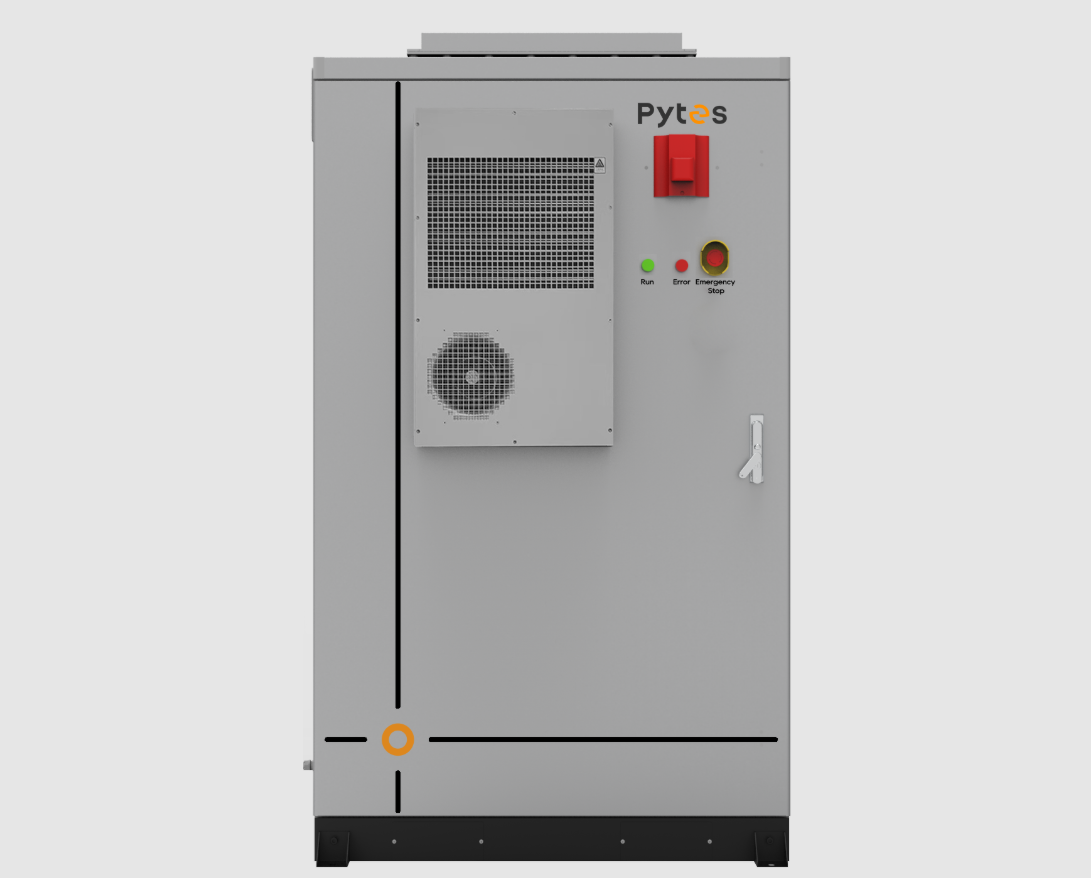
The Pytes HV48100 SE is designed around these requirements. With an IP55 enclosure, an operating temperature range of -20°C to 55°C, modular high-voltage architecture, active fire protection, air cooling, heating film, and module-level fans, the system is positioned for outdoor energy storage applications where environmental adaptability and system safety are critical.
One of the most important characteristics of the HV48100 SE is its IP55-rated enclosure. This provides protection against dust and water ingress and allows the system to be deployed in both indoor and outdoor environments according to the applicable installation requirements.
This matters for commercial and industrial projects where dedicating a conditioned indoor battery room may increase construction complexity and installation cost. Outdoor deployment can provide greater flexibility for applications such as commercial facilities, critical infrastructure, schools, hospitals, and distributed energy projects.
The system is designed to operate from -20°C to 55°C (-4°F to 131°F). Instead of relying on a single thermal management approach, the HV48100 SE combines air cooling for high-temperature conditions, built-in module-level fans to reduce internal temperature variation, and integrated heating film for cold environments.
This multi-layer thermal strategy is particularly relevant in North American markets, where an outdoor ESS may experience substantial seasonal temperature differences.
For energy storage systems, voltage and current are closely connected to power transmission losses. At the same power level, increasing system voltage allows the required current to decrease.
The HV48100 platform uses a high-voltage architecture with a 200–870V controller working voltage range, while individual battery modules are rated at 51.2V, 100Ah, and 5.12kWh. The documented system configuration can use 5 to 15 battery module units, providing 25.6–76.8kWh of nominal energy with a 237.5–864V nominal system voltage.
This architecture is particularly useful for commercial applications where battery capacity and power requirements are significantly higher than those of conventional low-voltage systems.
Higher system voltage can reduce current for a given power output, which can help reduce resistive losses and associated heat generation in the power path. Pytes specifically identifies reduced current-related losses as an advantage of its HV architecture.
The HV48100 architecture does not lock a project into one fixed battery capacity. Each battery module provides 5.12kWh of nominal energy, and systems can be configured with 5–15 BMUs. This produces a documented nominal energy range from 25.6kWh to 76.8kWh per system configuration.
This modular approach is valuable when project capacity may change during design or when future expansion is expected.
For example, a smaller commercial installation may begin with approximately 25.6kWh of battery capacity, while a larger installation can use additional modules to approach the upper end of the configuration range. Pytes also states that the HV48100 SE architecture can scale toward MWh-level capacity through modular system expansion.
The benefit is not simply additional capacity. Modular architecture can simplify system planning because battery capacity can be matched more closely with actual load profiles, solar generation, backup requirements, and future expansion plans.
A commercial battery is a long-term energy asset. The initial kWh rating is only one part of its value; cycle life and usable capacity over time are equally important.
The HV48100 platform uses LFP chemistry and specifies a cycle life of ≥6,000 cycles under the stated test conditions. The system also specifies a 90% recommended depth of discharge and a 10-year warranty.
If a system is cycled frequently for applications such as solar self-consumption, peak shaving, demand management, or backup preparation, these specifications become directly relevant to lifecycle planning.
The 6,000-cycle specification should not be interpreted as a universal lifetime under every operating condition. Actual battery life depends on temperature, depth of discharge, charge/discharge rate, operating strategy, and other conditions. Nevertheless, it provides an important reference when comparing commercial storage platforms.
Outdoor battery deployment requires a different safety approach from simply placing battery modules inside a protected room.
The HV48100 SE incorporates multi-layer active fire protection, including detection and ventilation, aerosol suppression, pressure relief, and a fire hose port. The product page also identifies UL 9540, UL 9540A, and UL 1973 among its compliance-related standards, alongside NFPA 68/69/855 references.
This layered approach is significant because ESS safety involves multiple stages: detecting abnormal conditions, managing thermal events, controlling pressure, and limiting the consequences of a potential incident.
For projects in critical infrastructure environments, these features can become important considerations alongside capacity and efficiency.
Battery performance depends heavily on communication between the battery management system, inverter, and supervisory controls.
The HV48100 platform supports CAN, RS485, dry contact, and Wi-Fi communication, while its self-designed BMS is intended to provide intelligent battery management.
This communication flexibility can simplify integration with different system architectures and support monitoring of battery operating conditions.
The product is also designed to work with major inverter brands, giving system designers greater flexibility when selecting the power conversion equipment.
The combination of IP55 protection, -20°C to 55°C operation, 25.6–76.8kWh documented system capacity, 50A continuous charge/discharge current, LFP chemistry, ≥6,000-cycle life, and 10-year warranty makes the HV48100 SE particularly relevant to applications where reliability, scalability, and environmental adaptability matter.
Potential applications include commercial and industrial energy storage, critical facilities, distributed solar-plus-storage systems, backup power, and other projects requiring outdoor high-voltage battery architecture.
Pytes Energy has established itself as a trusted energy storage brand by developing solutions around the practical requirements of residential and commercial energy storage. Its portfolio covers low-voltage server rack batteries, stackable modular systems, and high-voltage solutions, allowing different projects to select an architecture that matches their power and installation requirements.
The HV48100 SE represents this approach at the high-voltage outdoor level: rather than focusing on a single headline specification, it combines 5.12kWh modular battery units, high-voltage operation, IP55 protection, multi-layer fire protection, all-weather thermal management, flexible communication, and scalable architecture into one energy storage platform.
For commercial energy storage projects, that combination can be more meaningful than capacity alone. The real measure of an ESS is how reliably it can store, deliver, protect, monitor, and scale energy under the conditions in which it will actually operate.