As commercial and industrial energy systems become more power-intensive, battery storage is increasingly expected to do more than provide backup power. Peak shaving, solar self-consumption, microgrid operation, EV charging, and load management require a storage system that can deliver substantial energy capacity, stable power output, thermal control, and safety protection within a commercially practical cabinet architecture.
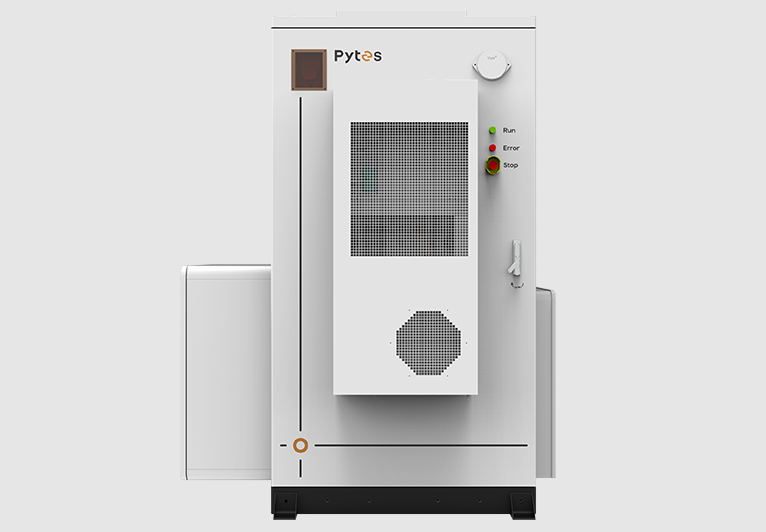
The Pytes HV48300 Max SE is designed around these requirements. Its high-voltage architecture combines 314Ah Tier-1 automotive-grade LFP cells, up to 225.075 kWh nominal energy in its maximum internal configuration, 112.53 kW nominal output power, a 157A recommended charge/discharge current, and 205A peak current capability. The system also integrates IP55 protection, active thermal management, multi-layer fire suppression, and scalable battery architecture for commercial and industrial energy storage.
One of the most important advantages of the HV48300 Max SE is its ability to combine high energy density with a high-voltage system architecture.
The system supports flexible battery configurations, with up to 15 battery modules in series for a 15S1P configuration or a 7S2P configuration. According to Pytes specifications, the maximum configurations provide 225.075 kWh and 192.912 kWh of nominal energy respectively. The corresponding nominal output power is 112.53 kW for the 15S1P configuration and 96.45 kW for the 7S2P configuration.
The 15S1P configuration operates across approximately 672–864V, while the 7S2P configuration operates across approximately 313.6–403.2V. This wide voltage flexibility allows the system architecture to accommodate different inverter and application requirements instead of locking a project into a single electrical configuration.
For a facility requiring around 100 kW of battery power, this configuration is particularly relevant because the storage system can provide more than 200 kWh of energy within a single cabinet architecture. That creates an approximate two-hour energy-to-power relationship at rated output, although actual operating duration depends on load profile, usable energy, inverter efficiency, temperature, SOC limits, and other system conditions.
The HV48300 Max SE uses 314Ah Tier-1 automotive-grade lithium iron phosphate (LFP) cells. The larger cell capacity is not simply a specification upgrade; it affects the physical architecture of the battery system.
Using larger-capacity cells can reduce the number of individual cells and internal connections required for a given energy capacity. Pytes specifically positions the 314Ah cell architecture around higher density and fewer connections.
For commercial systems, fewer internal connection points can simplify the electrical architecture and potentially reduce connection-related failure points. Combined with the modular battery structure, this creates a more straightforward path from individual battery modules to a high-voltage storage cabinet.
LFP chemistry is also well suited to frequent-cycling stationary storage because of its thermal stability and long-cycle characteristics.
Power delivery is another important parameter for C&I applications.
The HV48300 Max SE provides a 157A recommended charge/discharge current, with peak charge/discharge capability reaching 205A under specified short-duration conditions.
This matters in applications where the load is not constant. Manufacturing equipment, refrigeration systems, pumps, compressors, and EV charging infrastructure can generate rapid changes in power demand.
A storage system must therefore be evaluated not only by total kWh but also by its ability to handle these power transitions.
The combination of approximately 112.53 kW nominal output power and high-voltage operation gives the HV48300 Max SE a suitable architecture for commercial facilities where battery power must interact directly with substantial electrical loads.
A commercial battery system can be subjected to hundreds of charge and discharge cycles every year. Therefore, cycle life has a direct relationship with long-term asset value.
The HV48300 Max SE is specified for 6,000 cycles under the stated operating conditions, with the battery warranty covering 10 years or 6,000 cycles, whichever comes first. The cabinet system has a 3-year warranty, with an optional two-year extension available.
For a system used for daily peak shaving, solar energy shifting, or other repeated cycling applications, this specification provides a measurable basis for evaluating lifecycle economics.
Instead of comparing systems only by initial battery price per kWh, project evaluation can consider expected usable energy, cycle frequency, end-of-life capacity, warranty conditions, and the expected operating period.
Commercial storage equipment is often installed outside dedicated battery rooms. This makes enclosure protection an important engineering parameter.
The HV48300 Max SE uses an IP55-rated enclosure, designed for protection against dust ingress and water exposure. Pytes positions the system for both indoor and outdoor applications.
The specified operating environment is also broad. The system supports charging from 0°C to 55°C and discharging from -25°C to 55°C, with relative humidity from 5% to 95% non-condensing and an operating altitude of up to 2,000 m.
This operating range is important for North American commercial installations where battery systems may face substantial seasonal temperature differences.
Thermal management is one of the most important factors in maintaining battery performance.
The HV48300 Max SE integrates active air cooling with a rated cooling capacity of 5,000W at L35 conditions and a maximum heating capacity of 2,500W. Module-level fans help reduce internal temperature differences between battery modules.
This active thermal architecture is particularly valuable when the battery operates under sustained charge/discharge loads.
Temperature uniformity matters because battery modules operating at different temperatures can experience different electrical and aging characteristics. Active cooling therefore supports not only immediate operating stability but also more consistent long-term battery behavior.
For C&I energy storage, safety needs to be addressed at multiple levels.
The HV48300 Max SE incorporates a four-stage active fire protection architecture. The first stage uses hazardous-gas detection and ventilation. The second uses heat and smoke detection to activate aerosol fire suppression. The third provides pressure relief if internal pressure exceeds defined limits. The fourth incorporates a dedicated fire-hose connection port for external firefighting intervention.
The system is also listed with UL 9540 Ed.3 (2023), UL 9540A, UL 1973, and UN 38.3 certifications.
This combination is important for projects where system safety, permitting, transportation, and deployment requirements must be addressed together.
Commercial energy requirements rarely remain fixed throughout the life of a facility.
A business may initially install storage for peak shaving and later add capacity for solar integration, backup power, EV charging, or additional production loads.
The HV48300 Max SE uses a modular architecture that supports flexible battery-module configurations and parallel expansion toward MWh-level energy storage.
This modular approach can make capacity planning more practical because the system can be configured according to current requirements while providing a pathway for future expansion.
For large commercial projects, scalability should therefore be considered during the initial electrical design rather than treated as an afterthought.
Another practical feature is the cabinet's integrated installation architecture.
Pytes states that major inverter systems can be mounted directly on the side of the cabinet, while the system also incorporates an integrated combiner box with a built-in circuit breaker.
This can reduce the amount of separate equipment required around the battery cabinet and help simplify installation.
For C&I projects, installation efficiency has a measurable commercial impact. Every additional cabinet, external connection, or separate protection component can increase installation labor, floor-space requirements, wiring complexity, and commissioning time.
The combination of approximately 225 kWh maximum nominal energy, more than 112 kW nominal output power, high-voltage operation, 6,000-cycle life, IP55 protection, active HVAC, and multi-layer fire protection makes the HV48300 Max SE particularly relevant to several applications.
For commercial peak shaving, the battery can charge during lower-cost periods and discharge during demand peaks, subject to the site's tariff structure and energy-management strategy.
For solar-plus-storage systems, its large energy capacity allows excess solar generation to be shifted toward evening or other periods when onsite demand remains high.
For microgrids, the modular high-voltage architecture provides a scalable energy-storage foundation that can be integrated with generation and power-conversion equipment.
For EV charging infrastructure, the approximately 112.53 kW nominal output configuration can help supplement grid capacity where charging demand creates substantial power peaks.
For light industrial and agricultural facilities, IP55 protection and a broad operating temperature range provide additional flexibility when the battery must operate outside a conventional indoor electrical room.
The technical value of the HV48300 Max SE becomes clearer when its specifications are considered as an integrated system rather than as isolated figures.
314Ah LFP cells provide the battery foundation. 225.075 kWh nominal energy provides substantial storage capacity within the maximum 15S1P configuration. 112.53 kW nominal output power supports high-demand commercial loads. 157A recommended current and 205A peak current provide flexibility for dynamic operating conditions. 6,000 cycles support repeated energy management. IP55 protection expands installation possibilities. 5,000W cooling and 2,500W heating capacity address thermal management. The four-level fire protection architecture adds another layer of system safety.
Taken together, these specifications position the HV48300 Max SE as a high-voltage C&I storage platform rather than simply a large battery cabinet.
The Pytes HV48300 Max SE is engineered for commercial and industrial energy storage applications where capacity, power, safety, environmental resilience, and scalability must work together.
With up to 225.075 kWh nominal energy, 112.53 kW nominal output power, 314Ah Tier-1 automotive-grade LFP cells, 6,000-cycle performance, IP55 protection, 5,000W cooling, 2,500W heating, and multi-layer active fire protection, the system provides a specification-driven solution for demanding C&I applications.
Pytes Energy has developed a broader storage portfolio covering low-voltage server rack batteries, stackable modular systems, and high-voltage solutions. Within this portfolio, the HV48300 Max SE addresses the segment where higher energy capacity, high-voltage integration, scalable architecture, and industrial-grade protection are central to system design.