The International Energy Agency (IEA) Global Energy Review 2026 highlights a structural shift in the global power landscape: battery energy storage is no longer an auxiliary technology for renewables, but a core component of modern electricity systems.
According to the report, global battery storage additions reached a record level in 2025, driven by accelerating electrification, rapid growth of renewable energy, and surging electricity demand from AI-driven data centers. More importantly, the global installed storage base has expanded more than tenfold compared with 2021, marking a clear transition from early-stage deployment to large-scale infrastructure buildout.
This evolution is reshaping how energy systems are designed, financed, and operated worldwide.
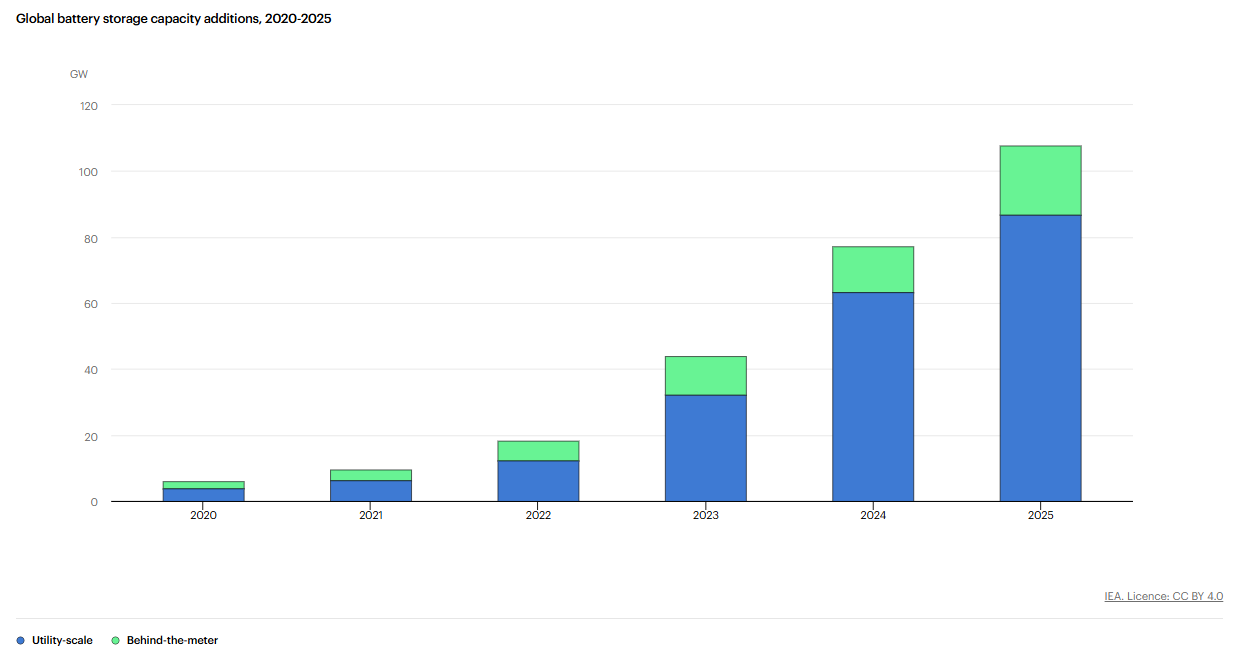
One of the most significant insights from the IEA report is the shift in the role of storage within power systems. Electricity demand growth is increasingly volatile, with AI computing loads, industrial electrification, and distributed renewable generation creating unpredictable supply-demand imbalances.
In this environment, battery storage is being deployed not only to store excess solar or wind power, but to actively stabilize grids, manage peak demand, and ensure reliability during extreme events.
In markets such as the United States and Europe, storage is now integrated into:
· grid frequency regulation
· peak shaving for industrial users
· renewable smoothing for solar and wind farms
· backup power for data centers
· distributed energy systems in residential sectors
This shift indicates that storage is becoming a structural pillar of energy security rather than a supporting component.
The report confirms a clear technological consolidation: lithium iron phosphate (LFP) batteries now account for the vast majority of newly deployed storage systems globally, reaching approximately 90% of installations in 2025.
The dominance of LFP is driven by a combination of performance and economic factors. Compared to nickel-based chemistries, LFP offers longer cycle life, improved thermal stability, lower system cost, and better suitability for high-frequency cycling applications.
These characteristics align directly with modern grid requirements, particularly in four-hour and emerging long-duration storage systems.
As a result, nearly all major storage markets, including China, the United States, and Europe, are converging toward LFP-based architectures.
While utility-scale projects dominate headline capacity growth, residential and commercial storage systems are evolving rapidly in terms of system design and user experience expectations.
Homeowners and small businesses are no longer evaluating storage systems purely based on capacity or price. Instead, decision factors are increasingly centered on installation efficiency, system compatibility, scalability, and long-term operational stability.
In this context, Pytes Energy has positioned its product strategy around practical deployment needs in real-world energy environments.
The company’s portfolio includes low-voltage rack-mounted battery systems, stackable modular energy storage solutions, and high-voltage configurations designed for more complex residential and commercial applications. These systems are engineered to simplify installation while maintaining compatibility with mainstream inverter platforms and hybrid energy systems.
The emphasis is not only on energy storage capacity, but on system integration efficiency and lifecycle usability.
Another key direction highlighted in the IEA report is the increasing importance of longer-duration storage systems. While two-hour systems still dominate current installations, demand for four-hour and extended-duration configurations is growing rapidly.
This shift is driven by several system-level changes, including midday solar oversupply, rising peak electricity pricing in industrial zones, and increasing variability from renewable generation.
As power systems become more renewable-intensive, energy shifting over longer time windows is becoming essential. Storage is no longer only about short-term balancing; it is increasingly about reshaping daily load curves.
This trend is directly influencing system architecture, pushing the industry toward higher voltage platforms, improved thermal management, and more advanced energy management systems (EMS).
Pytes Energy’s high-voltage storage solutions are aligned with this direction, supporting scalable configurations for both residential and light commercial applications where higher efficiency and system expansion flexibility are required.
The global storage industry is undergoing a fundamental transition from hardware-centric competition to system-level competition.
In earlier stages, cost per kilowatt-hour and battery cell performance were the primary benchmarks. Today, however, system reliability, safety architecture, software intelligence, and lifecycle cost optimization are becoming equally important.
Modern storage systems are expected to deliver:
· seamless integration with solar and grid systems
· intelligent energy management through EMS platforms
· remote monitoring and diagnostics
· scalable expansion capabilities
· long-term safety under high cycling conditions
This shift is particularly evident in mature markets such as Europe and North America, where certification standards and grid requirements are becoming more stringent.
In response to these evolving expectations, Pytes Energy has been strengthening its position as a trusted brand in the energy storage sector, focusing on delivering integrated solutions rather than isolated components.
Its systems are designed to support energy independence for both residential users and commercial operators, while ensuring stable performance under real-world operating conditions.
A broader transformation is also taking place in how storage is perceived. Instead of being treated solely as backup power, battery systems are increasingly viewed as tools for energy autonomy.
Households are using storage systems to optimize solar self-consumption and reduce reliance on the grid. Commercial users are deploying storage to manage peak demand charges and stabilize operational energy costs. In both cases, the goal is shifting toward greater control over energy flows rather than passive consumption.
This transition aligns closely with Pytes Energy’s positioning, where storage solutions are designed not only for reliability but also for enabling users to actively manage and optimize their energy usage.
The IEA Global Energy Review 2026 confirms that battery storage has entered a new phase of global expansion. It is no longer an emerging technology but a foundational element of modern power systems.
With rapid growth in grid-scale deployment, increasing dominance of LFP chemistry, rising demand for long-duration storage, and accelerating integration with digital energy systems, the storage industry is moving toward a more complex and system-driven future.
Within this evolving landscape, companies such as Pytes Energy are focusing on practical, modular, and scalable energy storage solutions that support both residential and commercial energy independence.
As global electricity demand continues to rise and energy systems become more decentralized and intelligent, storage will play an increasingly central role in defining how energy is produced, managed, and consumed.