In commercial and industrial (C&I) energy storage applications, system reliability is no longer defined by a single component. It depends on how battery chemistry, BMS architecture, thermal management, safety compliance, and scalability are integrated into one unified energy platform.
The Pytes HV48300 Max SE is designed specifically for this requirement.
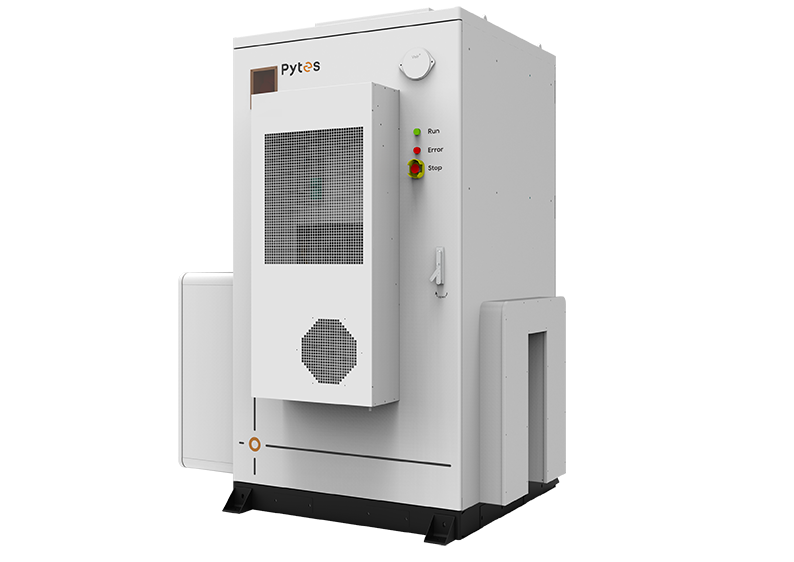
Built around Tier-1 automotive-grade LFP 314Ah cells, multi-level BMS monitoring, and a fully integrated IP55-rated outdoor cabinet system, the HV48300 Max SE delivers a high-capacity, high-safety, and highly scalable energy storage architecture for modern distributed energy systems.
It is engineered for real-world industrial environments where uptime stability, safety compliance, and lifecycle efficiency are non-negotiable.
At the core of the HV48300 Max SE is a lithium iron phosphate (LFP) battery architecture optimized for long cycle life and thermal stability.
Each battery module provides:
· Nominal capacity: 314Ah
· Nominal energy: 16.076kWh
· Nominal voltage range: 44.8V–57.6V
· Weight: 119 ± 5 kg (262 ± 11 lb)
LFP chemistry is selected specifically for its thermal stability and extended lifecycle performance in high-duty-cycle environments.
When configured into system-level architecture, the HV48300 Max SE supports two primary configurations:
· 7S2P configuration: 200.70kWh rated energy, 100.35kW rated power
· 15S1P configuration: 215.04kWh rated energy, 107.52kW rated power
This dual-architecture design allows flexible adaptation to different voltage and capacity requirements without changing core system hardware.
Operating voltage range expands significantly based on configuration:
· 313.6V to 4032V (7S2P configuration)
· 672V to 864V (15S1P configuration)
This wide operating window supports compatibility with multiple inverter platforms and system integration scenarios.
In industrial energy storage systems, battery management is the foundation of operational safety.
The HV48300 Max SE integrates a multi-level BMS monitoring architecture designed to manage:
· Cell-level voltage control
· Module-level balancing
· Pack-level coordination
· Real-time diagnostics and protection
This layered design ensures consistent monitoring across all operational conditions, especially under high-load or long-duration discharge cycles.
The system supports:
· Rated charge/discharge current: 140A × 2 (configuration dependent)
· Peak charge/discharge current: 170A for 60 seconds
These parameters allow the system to handle transient load fluctuations commonly seen in industrial and commercial power environments.
Safety compliance is a key requirement for commercial energy storage deployment, particularly in North America and global industrial markets.
The HV48300 Max SE is certified under:
· UL 9540 Ed.3 (2023)
· UL 9540A
· UL 1973
· UN 38.3
· NFPA 68 / 69 compliance framework
This certification stack ensures compliance with international standards for:
· System-level energy storage safety
· Thermal runaway testing
· Transportation safety
· Explosion protection design
Beyond certification, the system integrates a four-level active safety architecture designed for real-time hazard response:
Level 1: Hazardous gas detection activates ventilation system
Level 2: Heat and smoke detection triggers aerosol fire suppression
Level 3: Pressure relief valve automatically activates under abnormal internal pressure
Level 4: Fire hose connection port enables external firefighting intervention
This layered design ensures progressive mitigation across different risk stages, reducing the probability of system-level failure propagation.
The HV48300 Max SE is designed for harsh environmental deployment conditions.
The cabinet structure is rated IP55, ensuring protection against dust ingress and water exposure in outdoor and semi-outdoor installations.
Environmental operating ranges include:
· Charging temperature: 0°C to 55°C (32°F to 131°F)
· Discharging temperature: -25°C to 55°C (-13°F to 131°F)
· Operating humidity: 5%–95% non-condensing
· Operating altitude: ≤2000m
This allows deployment in a wide range of climates, from hot industrial zones to cold-region infrastructure sites.
The HV48300 Max SE integrates a dedicated air-cooling thermal system designed for continuous industrial operation.
Cooling system specifications:
· Maximum cooling capacity: 5000W (L35 condition)
· Maximum heating capacity: 2500W
· Built-in module-level fans
This architecture ensures stable thermal control across varying ambient conditions and high-load operation scenarios.
Compared with passive cooling systems, active air cooling significantly improves:
· Temperature uniformity across modules
· Battery cycle stability
· System efficiency under continuous operation
Scalability is one of the defining characteristics of the HV48300 Max SE.
The system is designed to scale seamlessly from single-cabinet deployment to multi-MWh distributed energy storage systems.
Key scalability features include:
· Modular battery design
· Configurable 1P (1 BCU) and 2P (dual BCU parallel) architecture
· Flexible BMU connection range: 1 to 15 modules (1P), 1 to 7 modules per BCU (2P)
· Parallel expansion capability for large-scale deployment
This allows system architects to design energy storage capacity based on actual load requirements rather than fixed system constraints.
The HV48300 Max SE is built in a high-density industrial cabinet format:
· Dimensions: 1200 × 1100 × 2250 mm (47 × 43 × 89 in)
· Weight: 2409 kg (5310.94 lb) to 2500 kg (5511.56 lb) depending on configuration
The structural design supports:
· High mechanical stability
· Outdoor installation durability
· Easy integration with inverter and power systems
The universal mounting structure enables compatibility with a wide range of inverter platforms, reducing system integration complexity.
For industrial energy storage systems, lifecycle performance is a critical economic factor.
The HV48300 Max SE delivers:
· Cycle life: 6000 cycles
· Battery system warranty: 3 years
· Battery module warranty: 10 years (or 6000 cycles, whichever comes first)
· Optional 2-year extended warranty
At 0.5C charge/discharge and 90% depth of discharge conditions, the system is designed to maintain approximately 70% end-of-life capacity retention.
This ensures predictable long-term operational performance for commercial deployments.
The system integrates remote monitoring and upgrade capabilities through Pytes Battery Cloud.
This enables:
· Real-time system performance monitoring
· Remote diagnostics and updates
· Energy usage analytics
· Predictive maintenance support
Combined with local service infrastructure and regional inventory availability, this ensures both digital intelligence and physical service responsiveness.
The HV48300 Max SE is optimized for:
· Commercial and industrial peak shaving
· Renewable energy integration
· Microgrid energy systems
· Backup power infrastructure
· Large-scale distributed energy storage
Its combination of high-voltage flexibility, modular scalability, and multi-layer safety architecture makes it suitable for demanding grid-connected and off-grid applications.
The HV48300 Max SE represents a high-density, high-safety, and highly scalable energy storage platform designed for modern commercial and industrial energy systems.
With 314Ah LFP cells, up to 215.04kWh per system configuration, UL-certified safety architecture, IP55 all-weather protection, multi-level fire suppression, and modular scalability up to MWh-level deployment, it is engineered to meet the evolving demands of industrial energy infrastructure.
As energy systems become more distributed, more intelligent, and more performance-sensitive, platforms like the HV48300 Max SE are becoming the foundation of next-generation commercial energy storage architecture.