As commercial and industrial energy demand becomes more volatile and electricity pricing more dynamic, energy storage systems are no longer evaluated only by capacity. They are now judged by how safely they operate under stress, how flexibly they scale, and how reliably they integrate into complex power environments.
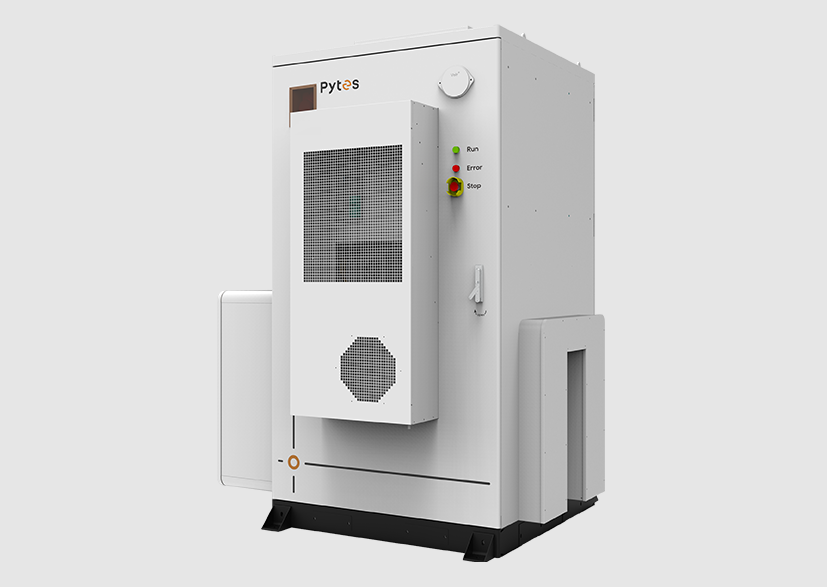
The Pytes HV48300 Max SE is designed precisely for this shift. Built around Tier-1 automotive-grade LFP 314Ah cells and engineered with a multi-level Battery Management System (BMS), it delivers a high-voltage, cabinet-based storage architecture tailored for commercial and industrial applications where uptime, safety, and scalability are non-negotiable.
At the system level, HV48300 Max SE is built to support high-energy-density deployment scenarios with configurations reaching up to 215.04kWh rated energy per system setup. Depending on architecture, it supports operating voltage ranges from 313.6V up to 4032V, enabling flexible integration into different industrial power infrastructures.
In practical deployment terms, this means a single system can deliver over 100kW of rated power output, with peak discharge capability reaching 170A for 60 seconds. This makes it suitable for applications where load spikes are frequent, such as manufacturing lines, cold storage facilities, EV charging hubs, and microgrid stabilization environments.
Unlike lower-voltage residential systems that require extensive parallel stacking for industrial use cases, HV48300 Max SE is designed to operate natively in high-voltage configurations, reducing system complexity and improving conversion efficiency at scale.
At the core of the system is lithium iron phosphate (LFP) chemistry using 314Ah Tier-1 automotive-grade cells. This choice is critical for industrial environments where long cycle life and thermal stability directly impact total cost of ownership.
Under standard operating conditions (25°C, 0.5C, 90% depth of discharge), the system is engineered to achieve up to 6000 cycles at end-of-life threshold performance. This level of durability is essential for applications requiring daily cycling or multi-shift energy dispatch strategies.
The nominal energy per battery module is 16.076kWh, with a module voltage architecture centered around 51.2V. Each module is designed to be integrated into larger cabinet configurations, enabling both 1P and 2P system architectures depending on capacity and redundancy requirements.
Industrial energy storage environments demand more than basic battery protection. HV48300 Max SE integrates a multi-level Battery Management System that continuously monitors voltage, current, temperature, and system health across multiple layers of control.
This architecture is paired with an integrated fire safety system that operates in staged response levels. Under abnormal conditions, hazardous gas detection triggers forced ventilation to reduce internal risk concentration. If thermal escalation occurs, an aerosol-based suppression system is activated automatically. In extreme cases, pressure relief mechanisms are designed to safely release internal pressure beyond defined thresholds, and a dedicated fire hose connection port is provided to support external firefighting intervention.
This layered approach aligns with internationally recognized safety frameworks including UL 9540, UL 9540A, UL 1973, and UN 38.3, ensuring compliance across global deployment environments.
Energy storage systems deployed in commercial and industrial environments often face fluctuating temperatures, enclosed installations, and continuous load cycles. HV48300 Max SE addresses this with an integrated air-cooling system supported by module-level fans, enabling active thermal regulation across all battery modules.
The system is rated for operation in ambient conditions ranging from -25°C to 55°C during discharge and 0°C to 55°C during charging. This wide operating window allows deployment in both cold-chain logistics environments and high-temperature industrial zones without requiring additional thermal engineering complexity.
The cabinet itself is designed with IP55 ingress protection, ensuring resistance against dust and water exposure, which is critical for semi-outdoor or industrial floor installations.
One of the defining characteristics of HV48300 Max SE is its modular scalability. The system is designed to support expansion from single cabinet configurations to multi-MWh energy storage clusters without requiring redesign of the core architecture.
Depending on configuration, the system supports flexible BMU connection structures ranging from 1 to 15 units per branch architecture, enabling both compact installations and high-capacity distributed deployments.
In multi-cabinet configurations, parallel system design allows energy scaling while maintaining consistent voltage behavior and control logic. This makes it suitable for microgrid deployments, peak shaving systems, and industrial energy arbitrage applications where capacity expansion must be incremental and predictable.
From a power delivery perspective, HV48300 Max SE is designed to support sustained industrial load profiles rather than short-duration consumer cycles. Rated charge and discharge current is set at 140A, with peak capability reaching 170A for short bursts.
This allows the system to handle sudden load transitions without voltage instability, which is critical in environments where equipment startup currents or process-driven load spikes are common.
The combination of high-voltage architecture and controlled current delivery improves overall system efficiency, particularly in applications where energy conversion losses directly affect operational cost.
Industrial energy systems must operate reliably across diverse geographic and environmental conditions. HV48300 Max SE is designed with an operating altitude limit of up to 2000 meters and relative humidity tolerance between 5% and 95% non-condensing conditions.
The system cabinet dimensions of 1200mm × 1100mm × 2250mm and weight of approximately 2.4 to 2.5 tons reflect its industrial-grade structural design, optimized for stationary deployment with long-term stability.
To support deployment flexibility, the system includes universal mounting structures and compatibility with multiple inverter types, enabling integration into existing energy infrastructures without requiring proprietary ecosystem constraints.
Beyond hardware performance, HV48300 Max SE integrates digital monitoring capabilities through Pytes Battery Cloud. This enables remote system diagnostics, performance tracking, and firmware-level upgrades without physical intervention.
In industrial deployments where energy continuity is critical, remote monitoring plays a key role in reducing maintenance downtime and enabling predictive service strategies.
Local inventory availability and regional service support further enhance deployment speed and lifecycle reliability, particularly in time-sensitive industrial installations.
The system is backed by a structured warranty model designed for long-term operational assurance. The battery system includes a 3-year system warranty, while individual battery modules are covered for up to 10 years or 6000 cycles, whichever comes first. An optional extension of 2 years is available, reflecting confidence in long-cycle durability under real-world operating conditions.
The HV48300 Max SE is not positioned as a generic energy storage product. It is designed as a high-voltage, modular, and safety-oriented energy infrastructure component for commercial and industrial environments where performance stability, scalability, and compliance are essential.
By combining Tier-1 LFP cell technology, multi-layer safety systems, IP55-rated environmental protection, and scalable MWh-level architecture, it provides a foundation for energy systems that must operate continuously, safely, and efficiently under industrial conditions.
In a market increasingly defined by electrification, distributed energy systems, and grid volatility, HV48300 Max SE is engineered to function not as an accessory to industrial operations, but as a core energy backbone supporting them.