The global energy landscape is entering a new phase as battery technology moves beyond electric vehicles (EVs) and becomes a core component of modern energy infrastructure. Once viewed primarily as a solution for vehicle electrification, advanced lithium battery technology is now becoming a critical foundation for residential energy independence, commercial power management, and grid-scale energy storage.
Recent moves by major automotive companies highlight this transition. Tesla, which entered the battery energy storage system (BESS) market years ago, has demonstrated the commercial potential of stationary storage. Now, other automotive giants including Ford and General Motors are expanding their energy storage strategies, recognizing that batteries can create new opportunities beyond traditional vehicle applications.
This industry shift is also creating opportunities for specialized energy storage companies such as Pytes Energy, which focuses on delivering reliable battery solutions designed specifically for residential and commercial energy storage needs.
For more than a decade, EVs have driven rapid innovation in lithium battery manufacturing. Improvements in battery chemistry, production scale, safety management, and cost optimization have created a mature technology foundation.
However, the future demand for batteries is no longer limited to transportation.
Energy storage systems are becoming increasingly important because renewable energy sources such as solar and wind are inherently variable. Electricity generated during the day may not match consumption patterns, creating a need for reliable storage solutions that can balance supply and demand.
The expansion of BESS applications includes:
· Residential solar energy storage
· Commercial and industrial peak shaving
· Backup power systems
· Microgrid applications
· Renewable energy integration
· Utility-scale grid stabilization
Industry analysts have highlighted the rapid expansion of the global BESS market, with expectations of significant growth throughout the next decade as demand for flexible energy infrastructure increases.
The automotive industry's move into energy storage is driven by several strategic factors.
Battery manufacturing expertise developed for EVs can be adapted for stationary storage applications. Companies already experienced in battery cells, thermal management, power electronics, and battery management systems (BMS) have a strong technological foundation for BESS development.
Tesla demonstrated this approach by building a dedicated energy business around battery storage products. Following this model, Ford has announced plans to enter the BESS sector, including the development of energy storage products for utilities, industrial customers, and emerging high-demand applications such as AI data centers. General Motors is also exploring energy storage opportunities while leveraging its battery and electrification expertise.
The reason is clear: energy storage is becoming a strategic market independent from EV growth cycles.
While EV batteries prioritize vehicle requirements such as weight reduction, charging speed, and driving range, stationary energy storage emphasizes:
· Long cycle life
· Safety
· Reliability
· Scalability
· Cost efficiency
This difference creates a new competitive landscape where specialized storage manufacturers can play an important role.
As the energy storage market evolves, customers are looking for battery systems that are not only powerful but also easy to install, safe to operate, and adaptable to different energy requirements.
Pytes Energy has positioned itself as a trusted brand in the energy storage industry by developing solutions designed specifically for residential and commercial applications.
Unlike a simple battery module, a modern storage system requires coordinated performance between battery cells, BMS technology, installation design, and system compatibility.
Pytes solutions focus on:
· Reliable lithium battery technology
· Flexible system configurations
· Simplified installation
· Long service life
· Stable energy management performance
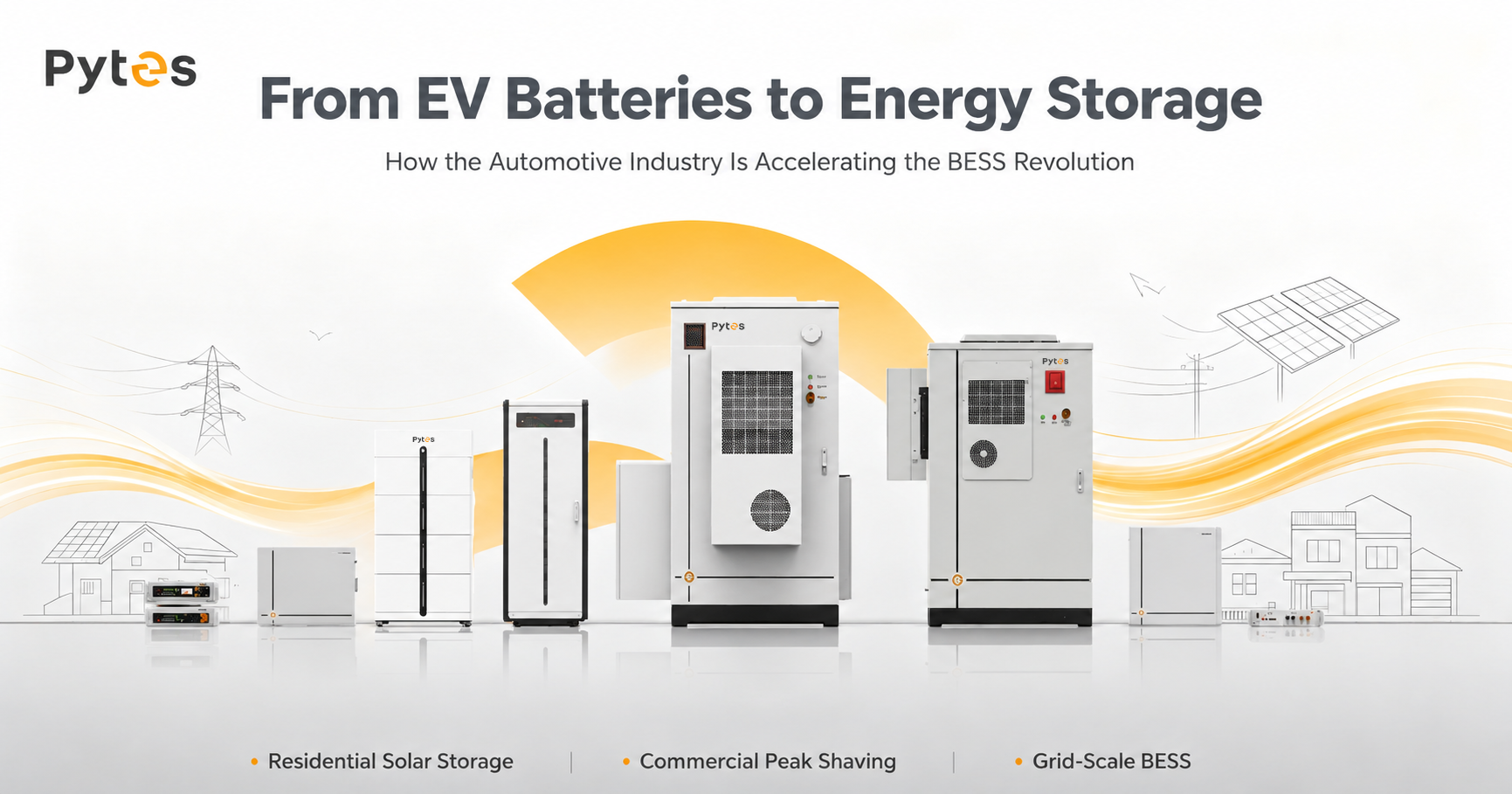
The product portfolio includes:
· Low-voltage server rack batteries
· Stackable modular battery systems
· High-voltage (HV) energy storage solutions
These solutions are designed to support different application scenarios, from residential solar storage to larger commercial energy management systems.
One major trend in the BESS market is the shift toward modular energy storage architecture.
Traditional fixed-capacity systems often create challenges when users need to expand storage capacity later.
Modular systems provide greater flexibility by allowing customers to increase capacity according to changing energy requirements.
For example, residential users may initially install a battery system to store excess solar power. As electricity consumption increases due to electric vehicles, home appliances, or changing energy policies, additional battery modules can be integrated without replacing the entire system.
For commercial users, modular designs simplify project planning by allowing energy storage capacity to match operational requirements.
Pytes stackable modular solutions are developed around this concept, providing easier installation and scalable energy expansion.
As battery storage expands into homes, businesses, and critical infrastructure, safety has become one of the most important evaluation factors.
Modern energy storage systems must address:
· Thermal management
· Battery protection
· Overcharge prevention
· Over-discharge protection
· Cell balancing
· Long-term stability
Lithium iron phosphate (LiFePO4) technology has gained popularity in stationary storage applications because of its strong thermal stability and long cycle life.
Compared with some high-energy-density chemistries, LiFePO4 prioritizes safety and durability, making it well suited for applications requiring years of reliable operation.
For users investing in energy independence, the goal is not simply storing electricity—it is achieving dependable power availability over the entire system lifecycle.
Another important change in the storage market is the growing demand for energy independence.
Rising electricity costs, grid reliability concerns, and increasing solar adoption are encouraging households and businesses to take greater control of their energy usage.
A solar-plus-storage system allows users to:
· Store excess solar energy
· Reduce grid dependency
· Manage peak electricity demand
· Maintain backup power during outages
For commercial facilities, battery storage can also support energy cost optimization by reducing peak demand charges and improving power management efficiency.
This transition from centralized energy consumption toward distributed energy systems is one of the biggest drivers of the global BESS market.
As more companies enter the energy storage market, competition will move beyond battery capacity and pricing.
The future leaders will likely be companies capable of delivering complete solutions, including:
· Reliable battery hardware
· Intelligent management systems
· Flexible installation options
· Strong safety performance
· Long-term technical support
Automotive companies bring large-scale manufacturing experience, while specialized energy storage companies bring application-focused expertise.
Together, these developments are accelerating innovation across the entire battery ecosystem.
The expansion of Tesla, Ford, and General Motors into battery energy storage demonstrates a fundamental transformation in the battery industry. Batteries are no longer limited to powering vehicles—they are becoming essential infrastructure for renewable energy, grid stability, and energy independence.
For this rapidly growing market, companies like Pytes Energy are helping shape the future of energy storage through reliable residential and commercial battery solutions. With low-voltage server rack batteries, stackable modular systems, and high-voltage solutions, Pytes provides flexible energy storage options designed for modern energy challenges.
As global demand for clean, resilient, and independent power systems continues to grow, advanced BESS technology will become a key driver of the next generation energy ecosystem.