Commercial energy systems are under increasing pressure from peak electricity pricing, unstable grid supply, and the rapid integration of distributed photovoltaic generation. In this environment, energy storage is no longer an auxiliary backup solution. It has become a core operating asset that directly affects electricity cost control, production stability, and energy resilience.
The HV48100 distributed energy storage system is designed for these real-world commercial and industrial conditions, where performance is defined not by theoretical capacity alone, but by cycle life, charging speed, system scalability, and long-term operational efficiency.
Built around a high-voltage cabinet architecture integrating battery modules, a control unit, and an intelligent BMS, the system focuses on measurable performance parameters that determine lifecycle value in continuous operation scenarios such as charging stations, factories, commercial buildings, and photovoltaic-storage hybrid systems.
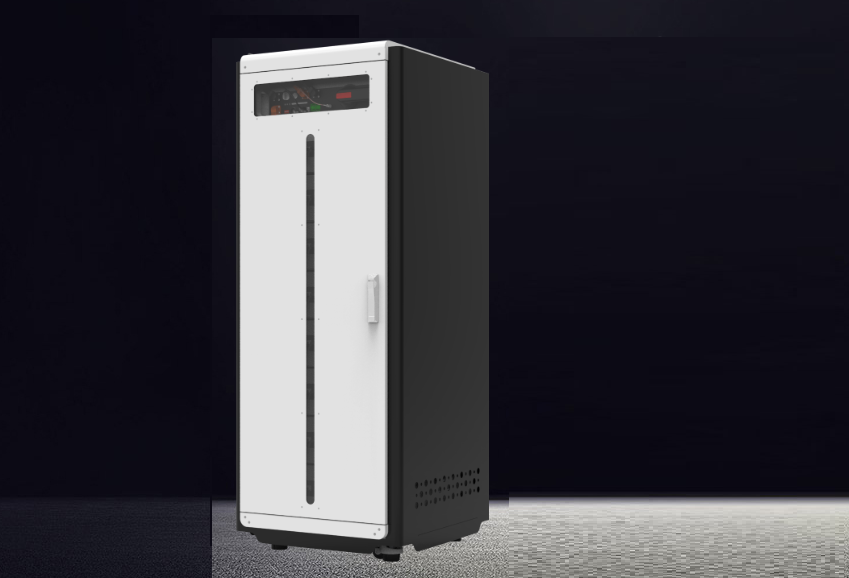
At the core of the HV48100 system is a high-performance LFP battery architecture designed for long-cycle commercial usage. The system delivers a cycle life exceeding 6000 cycles with up to 95% round-trip efficiency, positioning it for long-duration daily cycling applications.
In practical deployment scenarios where one full charge-discharge cycle is completed per day, this cycle life translates into more than a decade of operational continuity under standard usage conditions. This directly reduces battery replacement frequency and stabilizes long-term operating costs, which is particularly critical for applications such as peak shaving in industrial facilities or daily energy balancing in photovoltaic systems.
The use of LFP chemistry further improves thermal stability and operational safety under continuous cycling conditions, especially in environments where temperature fluctuations and high-frequency charge-discharge behavior are common.
Charging speed is a key performance differentiator in commercial energy storage applications, especially when systems are required to respond dynamically to electricity price variations or intermittent renewable energy input.
Each HV48100 module supports a peak continuous output of 2.56kW and can reach full charge within approximately 2 hours under optimal operating conditions. This fast charging capability enables efficient energy capture during low-cost electricity periods and rapid energy preparation for peak demand release.
In practical operation, this means the system can actively participate in daily energy arbitrage strategies rather than functioning solely as a static backup unit. For EV charging infrastructure and industrial loads with fluctuating demand profiles, fast energy turnover improves system responsiveness and utilization efficiency.
The HV48100 system supports modular expansion through 5 to 15 battery modules per system, offering three cabinet configuration options to match diverse installation scenarios and space requirements. With flexible series and parallel connectivity, the system enables seamless capacity growth—from small commercial deployments to large-scale industrial applications—expandable up to 460.8kWh total energy storage. This modular rack-based design ensures future-proof scalability, allowing businesses to adapt energy infrastructure dynamically as operational demands evolve.
Each BMU module is rated at 5.12kWh with a nominal 51.2V voltage and 100Ah capacity. This modular structure allows energy capacity to be adjusted incrementally rather than requiring full system replacement, reducing upfront investment pressure while maintaining long-term scalability.
Commercial and industrial electrical environments often experience load fluctuations and unstable grid conditions. The HV48100 system is engineered with a system voltage architecture supporting 45.5V to 58.4V per module and scalable voltage up to multi-module configurations.
The system maintains continuous 50Adc charging and discharging capability, ensuring stable energy output under sustained load conditions. The controller operating voltage range of 200V to 870V further enhances compatibility with distributed energy systems and hybrid photovoltaic-storage setups.
This wide operating range improves adaptability in weak-grid environments and supports stable integration into both new and existing electrical infrastructures.
The HV48100 adopts a fully integrated cabinet structure that combines battery modules, high-voltage control systems, and battery management functions into a single enclosure measuring 23.62 × 25.2 × 61.22 inches.
This integrated architecture reduces system complexity by minimizing external wiring and separate component installation. Communication interfaces including CAN, RS485, Dry Contact, and WiFi allow direct integration into energy management systems and remote monitoring platforms.
By consolidating system components, installation time is reduced while improving operational coordination between battery modules and control logic.
Battery management plays a critical role in maintaining long-term system stability. The HV48100 integrates an intelligent battery management system that continuously monitors voltage, current, temperature, and system communication status.
The BMS ensures balanced operation across modules, improving consistency in multi-module configurations ranging from 5 to 15 BMUs per system. This is particularly important in distributed configurations where uneven load distribution can impact overall system efficiency and lifespan.
Real-time monitoring also enhances operational visibility, enabling early detection of abnormal conditions and improving system reliability during long-term continuous cycling.
The system is designed to operate under a temperature range of -4°F to 140°F, with storage capability down to -22°F. This wide environmental tolerance supports deployment in diverse commercial and industrial environments, including factories, outdoor charging stations, and photovoltaic hybrid installations.
Stable performance across temperature variations ensures consistent battery behavior and reduces performance degradation in non-climate-controlled environments.
The HV48100 system complies with UL1973 and UN38.3 standards, with UL9540 and UL9540A certification processes underway. These certifications are increasingly required for commercial energy storage deployment, particularly in regulated markets where safety validation and fire protection standards are mandatory.
Certification compliance ensures compatibility with international project requirements and improves deployment readiness across global commercial energy storage markets.
The HV48100 distributed energy storage system is engineered around measurable performance parameters that directly impact commercial energy operation efficiency. Rather than focusing on isolated specifications, the system integrates cycle life, charging speed, voltage stability, modular scalability, and intelligent control into a unified operational platform.
With more than 6000 cycles of lifespan, 95% efficiency, 2-hour fast charging capability, the system is designed for continuous-duty commercial environments where energy stability and cost control are critical.
As commercial energy systems continue transitioning toward distributed and intelligent architectures, storage solutions defined by clear operational parameters and scalable system design are becoming essential infrastructure rather than optional equipment.