The global energy storage market is entering a decisive phase. According to recent analysis from S&P Global, battery storage is rapidly emerging as the primary driver of lithium demand growth, signaling a structural shift in how energy systems are built and optimized.
For years, lithium demand was closely tied to electric vehicles. Today, that relationship is changing. Grid-scale storage, residential energy systems, and commercial applications are accelerating faster than expected—reshaping both the supply chain and system design priorities.
This shift is not only about materials. It is about how energy is stored, distributed, and managed in a world increasingly powered by renewables.
The S&P Global report highlights a striking trend: lithium demand from energy storage is projected to surge significantly, with estimates suggesting it could grow more than 2.5 times by 2030. At the same time, near-term growth remains strong, even as certain markets experience temporary policy-driven adjustments.
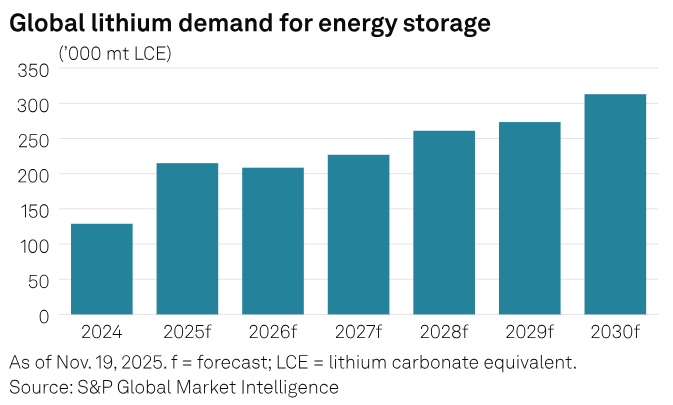
This expansion is being driven by real infrastructure needs rather than speculative growth:
· Solar and wind capacity continue to expand globally
· Grid instability is increasing due to intermittent generation
· Electricity demand from AI, electrification, and digital infrastructure is rising
In practical terms, energy storage is no longer a balancing tool. It is becoming a core layer of the energy system.
While the long-term outlook remains strong, the market is currently undergoing a period of recalibration.
S&P Global notes that global battery storage installations may see a slight dip in 2026, largely due to policy changes in China. The removal of mandatory storage requirements for renewable projects has reduced short-term demand, particularly in a market that previously accounted for a significant share of global installations.
However, this shift is not a contraction—it is a transition from policy-driven deployment to market-driven adoption.
In this new phase:
· Projects must meet stricter economic return criteria
· System efficiency and lifecycle performance are under greater scrutiny
· Technology selection is becoming more application-specific
This evolution favors companies that can deliver not just batteries, but reliable, adaptable energy storage systems.
One of the most important implications of the report is the rebalancing of lithium demand between electric vehicles and stationary storage.
While EV adoption continues, its growth rate is stabilizing. In contrast, energy storage is accelerating, particularly in:
· Utility-scale battery energy storage systems (BESS)
· Commercial and industrial (C&I) applications
· Residential energy storage paired with rooftop solar
This shift is redefining performance priorities.
In EVs, energy density and weight are critical. In energy storage, the focus moves toward:
· Cycle life and long-term stability
· System safety and certification
· Cost per kWh over the full lifecycle
· Ease of installation and scalability
These requirements are driving innovation in system architecture and product design.
Another key trend is the rapid growth of distributed energy systems. Instead of relying solely on centralized power plants, energy storage is increasingly deployed at the edge of the grid—closer to where energy is consumed.
This includes:
· Residential solar-plus-storage systems
· Small commercial backup and peak-shaving solutions
· Modular storage for microgrids and off-grid applications
In these scenarios, flexibility and user experience become critical. Systems must be:
· Easy to install and expand
· Compatible with multiple inverters and energy platforms
· Reliable under varying load conditions
This is where companies like Pytes Energy are aligning closely with market needs.
With over 20 years of experience in energy storage, PYTES (USA) Energy, INC has focused on delivering modular, application-driven solutions that support both residential and commercial use cases. Its portfolio—ranging from low-voltage server rack batteries to stackable modular systems and high-voltage solutions—reflects the industry’s shift toward scalable and flexible deployment models.
Rather than treating storage as a standalone product, the approach is increasingly system-oriented, enabling users to build energy independence step by step.
As energy storage moves into mainstream infrastructure, reliability is no longer optional. System failures can result in operational disruption, safety risks, and financial loss.
This is driving stronger emphasis on:
· Certified system design (such as UL9540)
· Battery management systems (BMS) with real-time monitoring
· Thermal management and safety architecture
· Long-term performance consistency
For end users, especially in North America, certification is not just a compliance requirement—it is a key purchasing factor.
Pytes, for example, has positioned its solutions around UL9540-certified systems, ensuring that safety and performance standards align with regulatory and market expectations. Combined with localized service and support, this reduces deployment risk and improves long-term system reliability.
The lithium market has experienced significant price volatility over the past few years. While raw material costs have declined from previous peaks, uncertainty remains due to supply chain dynamics and geopolitical factors.
At the same time, customers are becoming more sophisticated in how they evaluate cost.
Instead of focusing only on upfront pricing, decision-making is increasingly based on:
· Total cost of ownership (TCO)
· System lifespan and degradation rate
· Maintenance and replacement costs
· Energy savings and return on investment
This shift aligns with the broader trend toward value-driven procurement.
Energy storage providers that can optimize system efficiency, simplify installation, and ensure long-term reliability are better positioned to compete in this environment.
As deployment scales globally, operational factors are becoming just as important as technical specifications.
Customers now expect:
· Faster delivery timelines
· Local technical support
· Simplified installation processes
· Responsive after-sales service
Pytes has addressed this by building localized service capabilities, particularly in key markets such as North America. By combining manufacturing expertise with regional support, the company is able to reduce lead times and improve customer responsiveness.
This operational agility is becoming a key differentiator as the market matures.
The implications of the S&P Global analysis extend far beyond lithium demand.
They point to a broader transformation:
· Energy storage is becoming a foundational component of modern energy systems
· Demand growth is shifting from mobility to infrastructure
· System-level performance is replacing component-level optimization
In this context, the role of energy storage providers is evolving. Success will depend on the ability to deliver:
· Scalable and modular solutions
· Certified and reliable systems
· Strong local support and service
· Continuous product innovation based on real-world feedback
With a global footprint across more than 60 countries and a strong focus on innovation, Pytes Energy is positioned within this transition—not just as a battery supplier, but as a contributor to smarter, more resilient energy systems.
The growth of lithium demand driven by battery storage is a signal of something much larger.
It reflects a shift from material-driven growth to system-driven value creation.
As energy systems become more decentralized, digitalized, and renewable-based, storage is no longer optional—it is essential.
For companies and users alike, the question is no longer whether to adopt energy storage, but how to do it more efficiently, safely, and strategically.
And in that transition, the ability to combine technology, reliability, and real-world usability will define the leaders of the next energy era.
Power a better life—with smarter energy storage.