UL 9540A now reflects stronger large‑scale fire testing expectations, while NFPA 855 2026 formalizes advanced fire & explosion testing requirements and Hazard Mitigation Analysis as default practice. This article will explain:
• What changed in UL 9540A Sixth Edition
• How NFPA 855 2026 incorporates, references and extends UL 9540A
• Where industry safety and permitting are headed
• Actionable implications for manufacturers, designers, AHJs, and system owners
1. Why Fire Testing Matters
Battery ESS products are growing in capacity, deployment scale, and operational complexity. Unlike passive infrastructure, electric storage involves thousands of electrochemical cells that can undergo thermal runaway — a rapid, uncontrolled exothermic reaction, leading to fire, gas emission, or explosion. Accurate testing methods are essential to quantify such risks and to set practical safety measures for installations ranging from residential rooftops to multi‑megawatt utility systems.
UL 9540A is the nationally recognized fire propagation test method used to generate data required by codes like NFPA 855 and IFC for installation design, separation distances, fire protection systems, and mitigation decisions.
2. UL 9540A Sixth Edition (2026)
2.1 Standard Scope and Purpose
UL 9540A is the Standard for Test Method for Evaluating Thermal Runaway Fire Propagation in Battery Energy Storage Systems. Its key goal is to produce empirical data on fire, explosion, and thermal propagation hazards within an ESS under controlled conditions.The data generated supports:
• Manufacturer installation instructions
• Determination of required separation distances between units
• Fire and explosion protection requirements
• Building and fire code compliance (NFPA 855, NFPA 1, NEC, IFC, IRC, etc.)
2.2 Key Changes in the Sixth Edition
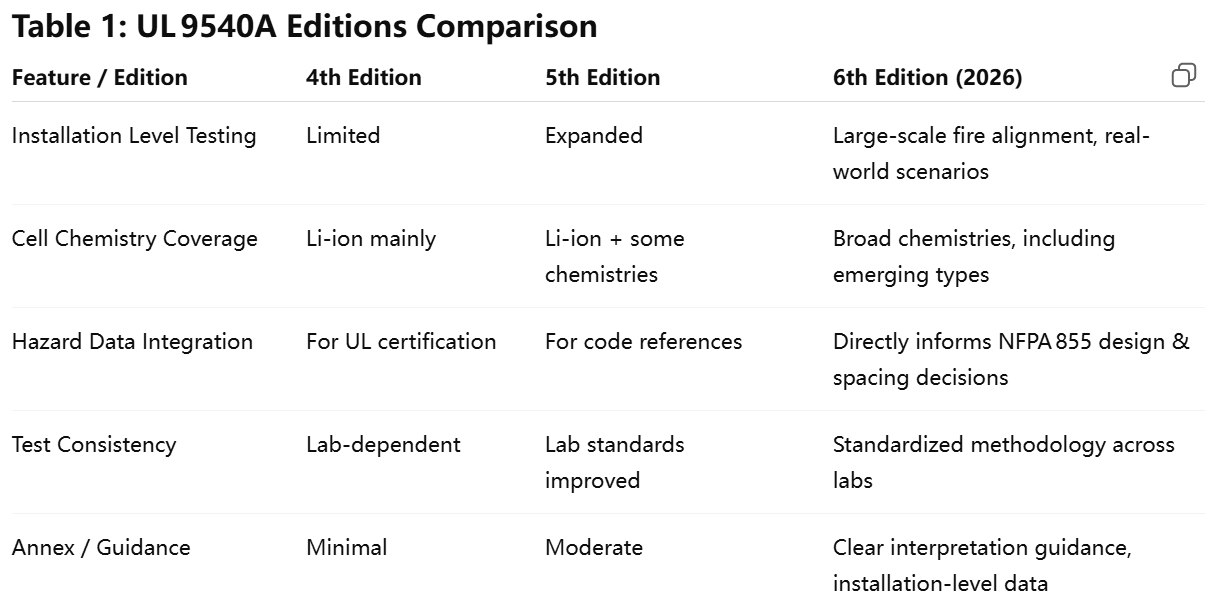
The Sixth Edition (ANSI/CAN/UL 9540A Sixth Edition, March 13 2026) incorporates several structural and methodological revisions:
1) Enhanced Testing for Large‑Scale Fire Behavior
• Installation level testing is revised to better reflect large‑scale fire scenarios and behaviors.
• This aligns with NFPA 855 2026 expectations for large‑scale fire testing data, bridging lab tests with real‑world policies.
2) Refined Test Sequence and Installation Level Requirements
• Provides clearer sequences from cell, module, unit, to installation level tests.
• Installation level testing can replace unit testing for sites requiring fire or separation data to satisfy codes.
3) Broader System Reference Application
UL 9540A data integrates with a wide range of codes and standards beyond NFPA 855, including:
• NFPA 1 (Fire Code)
• NFPA 70 (NEC)
• UL 9540 (ESS product safety)
• ICC IFC & IRC (building code)
• Canadian Electrical and Safety Codes
4) Greater Testing Consistency and Data Usability
• Test definitions and criteria refined for consistent data across laboratories.
• Clear interpretation and application guidance in Annex sections.
3. NFPA 855 2026 Edition: Fire & Explosion Testing and Hazard Mitigation
NFPA 855 is the core installation standard for stationary energy storage systems in the U.S., adopted widely by local authorities and code officials. The 2026 edition introduces notable structural changes:
3.1 Formalizing Fire & Explosion Testing Requirements
The 2026 edition relocates and expands fire testing criteria:
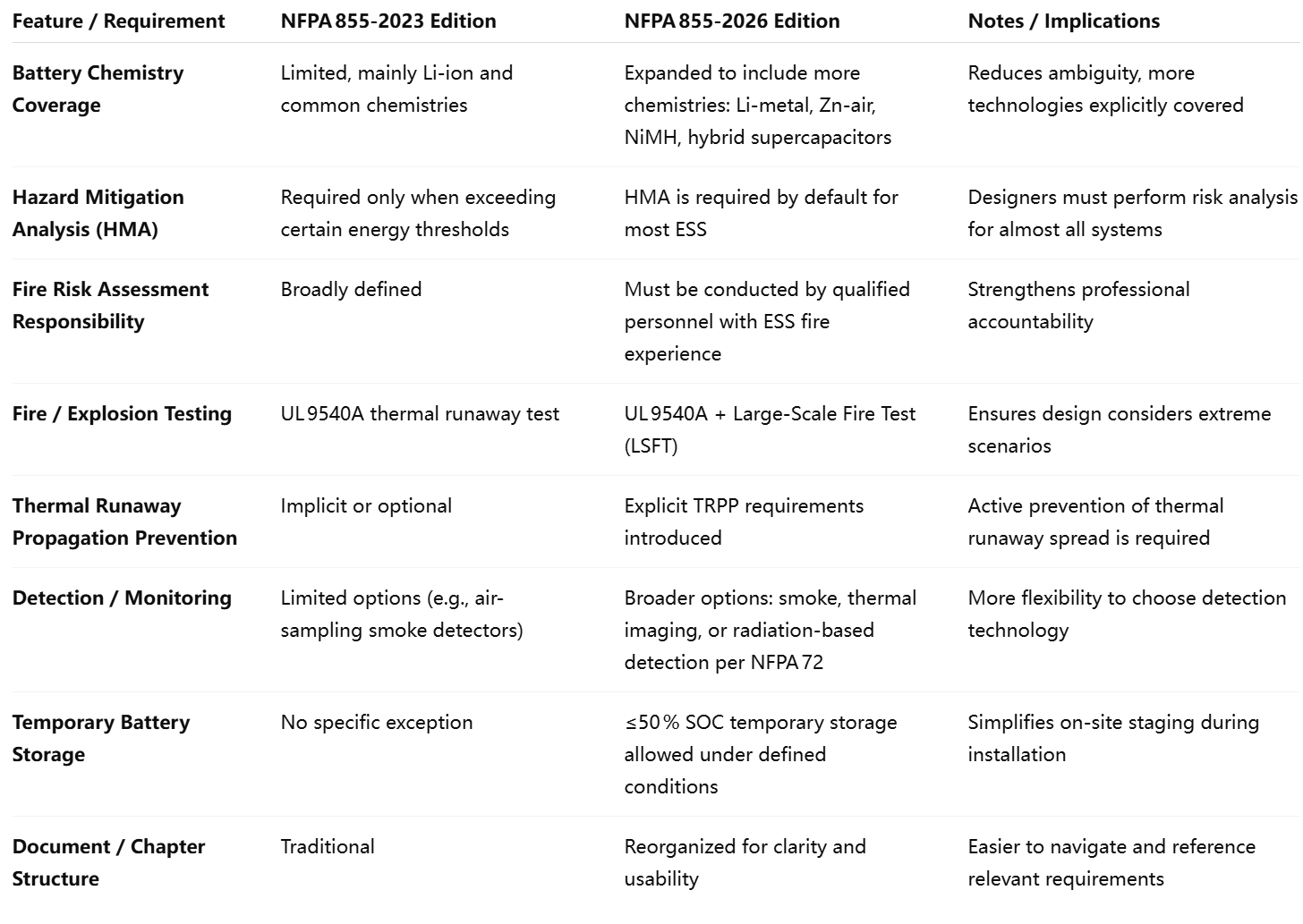
Fire & explosion testing is now expressed as UL 9540A PLUS large‑scale fire testing to collect more comprehensive hazard data covering:
1)Gas production at the cell level
2)Thermal runaway propagation potential at module level
3)Interaction and propagation between multiple ESS units.
This means that merely referencing UL 9540A for fire hazards (as in earlier editions) is not enough; the standard now expects both UL 9540A level data and data representative of larger fire events in order to support specific design concessions (e.g., reduced spacing, alternate fire suppression).
3.2 Expansion of Annex G Guidance
Annex G of NFPA 855 2026 offers implementation guidance for large‑scale fire tests, anticipating results that inform design and permitting decisions. This annex signals that industry and AHJs should expect deeper fire hazard data integration.
3.3 Hazard Mitigation Analysis (HMA) as Default
The new edition broadens Hazard Mitigation Analysis requirements, shifting from a conditional requirement (only in some cases) to a default practice for most installations. This ensures that planners model realistic worst‑case fire scenarios early in project development.
Table 2: NFPA 855 2026 vs 2023 version comparison table
4. Practical Implications for Industry
4.1 Permitting and AHJ Expectations
• Projects without UL 9540A fire data plus large‑scale test inputs risk delayed approvals or extra mitigation requirements under NFPA 855 2026.
• AHJs may require explicit demonstration of thermal runaway fire risk data for spacing, suppression, and alternative design paths.
4.2 Manufacturer & Designer Considerations
• Design teams must plan for installation level hazard testing early, not just unit‑level certification.
• Large‑scale fire test data may become a prerequisite for alternative code compliance options (e.g., reduced separation, suppression alternatives).
• System instructions and design documentation must reference UL 9540A output data and interpret it in context of site fire risk analyses.
4.3 Market & Investment Impact
Compliance with UL 9540A plus NFPA 855 2026 fire testing standards can significantly influence:
• Insurance eligibility and premium rates
• Investor confidence in project risk profiles
• Project timelines — especially for utility‑scale and commercial ESS deployments.
5. Key Takeaways
i: UL 9540A Sixth Edition strengthens large‑scale fire evaluation methodology and expands the role of installation level data in safety and code compliance.
ii: NFPA 855 2026 integrates UL 9540A fire data with large‑scale testing expectations, making fire hazard analysis a fundamental part of ESS permitting.
iii: Both standards together push the industry toward deeper empirical fire risk data, real‑world hazard mitigation analysis, and stronger engineering documentation.
6. Strategic Recommendations
To align with the evolving regulatory landscape:
• Plan for early engagement with certified testing labs capable of UL 9540A + large‑scale fire tests.
• Integrate HMA studies into project designs before permit submission.
• Work with fire protection engineers experienced in NFPA 855 2026 compliance.
• Document test results, hazard analyses, and mitigation strategies comprehensively for AHJs and insurers.