As residential solar and backup power systems continue to require higher usable capacity, reliable power output, and flexible expansion, battery specifications have become increasingly important in system design. The Pytes V5 is a 51.2V 100Ah lithium iron phosphate (LFP) battery with 5.12kWh of nominal energy per module. It combines up to 100A charge and discharge current, more than 6,000 cycles, and a modular architecture that can be expanded for larger energy storage systems.
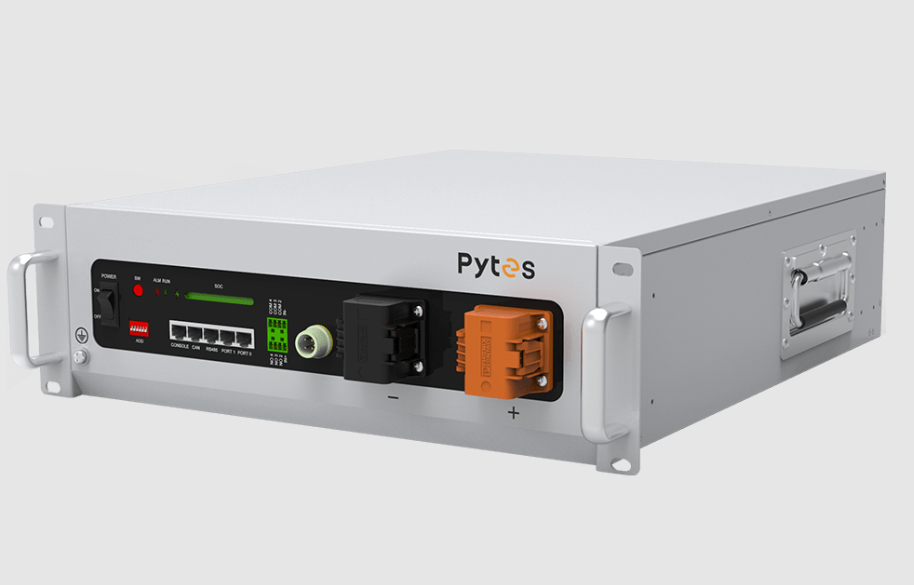
The Pytes V5 uses a 51.2V nominal voltage and 100Ah capacity, providing 5.12kWh of energy in a single battery. Its operating voltage range is approximately 47.5V–57.6V, making it suitable for compatible 48V-class residential and distributed energy storage systems.
The 5.12kWh capacity provides a practical starting point for applications such as solar self-consumption, nighttime energy shifting, and backup power. More importantly, the V5 is designed as a modular battery rather than a fixed-capacity storage unit, allowing users to increase total capacity by adding additional batteries.
For an energy storage battery, nominal capacity does not fully describe its performance. The maximum charge and discharge current determines how much power the battery can deliver to the inverter and connected loads.
The Pytes V5 has a recommended charge and discharge current of 75A and a maximum continuous current of 100A. At the nominal 51.2V voltage, 75A corresponds to approximately 3.84kW of DC power, while 100A corresponds to approximately 5.12kW.
The battery also supports higher short-term current. According to its specifications, it can operate at 101–120A for up to 3 minutes and 121–180A for up to 15 seconds under specified conditions. This provides additional power headroom for short-duration demand peaks, including motor or compressor startup.
For system designers, these figures provide a clearer basis for matching the battery with the inverter. Instead of evaluating the battery only by its 5.12kWh capacity, the combination of 75A recommended current and 100A maximum continuous current gives a more practical indication of its power capability.
The V5 uses lithium iron phosphate chemistry, a battery technology widely applied in stationary energy storage. Its specified cycle life exceeds 6,000 cycles, while round-trip efficiency is above 95%.
For a solar-plus-storage system that charges during the day and discharges at night, repeated cycling is a core operating requirement. A cycle rating above 6,000 provides a substantial lifecycle reference for applications involving frequent charge and discharge rather than occasional emergency backup.
The V5 also supports a charging temperature range of 0°C to 45°C and a discharging temperature range of -10°C to 50°C. An integrated heating function further supports operation in colder environments, although actual system performance will still depend on installation conditions and battery operating parameters.
The V5 uses a 3.2U form factor and measures approximately 442 × 530 × 140mm, with a weight of around 44kg. Its rack-oriented structure allows the battery to be integrated into suitable battery cabinets and energy storage racks.
The compact module design is useful when installation space is limited. Instead of using one oversized battery, a system can be assembled from multiple 5.12kWh modules, making it easier to match storage capacity with actual electricity consumption and backup requirements.
This modular approach is also useful when the required capacity may increase over time. Additional batteries can be incorporated into a compatible system as energy demand or solar generation capacity grows.
The Pytes V5 can be configured with up to 16 batteries in a group. With each battery providing 5.12kWh, a 16-unit configuration provides 81.92kWh of nominal energy.
This capacity range allows the same battery platform to cover different project sizes. A residential installation may use only a few V5 modules, while larger agricultural, backup, or commercial applications can combine more units to reach substantially higher capacity.
With the corresponding multi-group architecture, the total system capacity can reach approximately 491.52kWh. The expansion path can therefore be expressed as 5.12kWh per module, 81.92kWh for 16 modules, and up to 491.52kWh for a larger multi-group configuration.
Battery communication is another important factor in an integrated energy storage system. The Pytes V5 supports CAN and RS485 communication, enabling the battery management system to exchange operating information with compatible inverters and other system components.
This becomes particularly important when several V5 batteries are connected in parallel. Battery voltage, current, temperature, and operating status can be monitored through the communication system, helping coordinate charging and discharging across multiple modules.
For installers and system integrators, communication compatibility should therefore be evaluated alongside voltage, current, and capacity when selecting the V5 for a specific ESS architecture.
The Pytes V5 combines a relatively compact 5.12kWh module with a 100A maximum continuous charge/discharge capability and scalable architecture. This makes it suitable for residential solar storage, backup power, off-grid systems, agricultural applications, and other distributed energy storage projects where modular capacity is important.
For a typical residential system, several V5 batteries can provide the required backup capacity without immediately moving to a much larger battery platform. For larger systems, additional modules can be added to increase total energy storage while retaining the same 51.2V LFP architecture.
The key specifications also make it easier to evaluate the V5 against project requirements. A designer can start with the required energy capacity, then consider the 75A recommended current, 100A maximum continuous current, inverter compatibility, temperature conditions, communication protocol, and required expansion capacity.
The Pytes V5 is built around a straightforward set of specifications: 51.2V nominal voltage, 100Ah capacity, 5.12kWh nominal energy, 75A recommended charge/discharge current, and 100A maximum continuous current. Its more than 6,000-cycle rating and greater than 95% round-trip efficiency further support applications involving frequent energy cycling.
Its main system-level advantage is the modular architecture. Starting from a 5.12kWh battery, the system can be expanded to 81.92kWh with 16 modules and to approximately 491.52kWh in a larger multi-group configuration. Combined with CAN/RS485 communication and a compact 3.2U design, these parameters make the V5 a configurable 51.2V LFP solution for residential and distributed energy storage applications.